|
| Andrew Airways Beaver floatplane at Kodiak seaplane port found at Katmai Bears |
I have a commercial pilot's license and used to work as a commercial seaplane pilot in Seattle and Alaska. I was asked to send you my thoughts on your blog idea for seaplane service between London and Suffolk.
Basically, I believe that seaplanes are only commercially practical for places that cannot be reached by road or airport, mostly limiting their destinations to roadless areas of Alaska and Canada, and islands where ferry routes are either very long or nonexistent.
I once spent a summer flying for a small flying service in Kodiak, Alaska. The Kodiak Island chain has one town (Kodiak) and six villages. All of these have airports and we virtually never had customers to go there. Instead, our destinations consisted of bear watching tours, and fishing, logging, and tourist sites in the wilderness. (Most of Kodiak Island has no road network.)
Here are the obstacles that seaplanes have to face when competing with small land planes or automobiles:
1: Seaplanes are costly to operate. Small land planes are already expensive per passenger mile in comparison with either cars or large airliners. Seaplanes have additional operating costs: the floats themselves cost about 40% of the price of the airplane, and sheet metal damage is frequent. The latter is caused by such things as submerged rocks, docks, and waves from passing boats and mishaps are mostly unavoidable due to the fact that seaplanes are meant to go where the environment is not closely controlled. In addition, seaplanes face salt-water corrosion and fuel costs (due to higher drag).
2: Seaplanes do not have much capacity. A seaplane has a few hundred pounds less useful load than the land plane version of the same type, due to the weight of the floats which must be subtracted from the max gross weight. This is the main reason we could not compete with land plane flights to the villages on Kodiak.
Your argument that seaplanes could reduce burdens on country roads in England doesn't appear to hold water. A busy seaplane operation could carry perhaps a few hundred passengers per week, which is an insignificant load for even the smallest dirt road.
The deHavilland Beaver has a cargo capacity of roughly 1200 pounds, the same volume as a small pickup truck, and seats six passengers at a maximum.
It's the real cost of increasing the capacity of roads that needs to be looked at. Widening the A12 will add 15kg CO2 to every car journey driving on it for ten years at present traffic. Every flight will emit 4.375 kg per passenger, that's less than the cars now driving it. Dornier and other aircraft manufacturers are continuing seaplane (or more properly amphibious) R&D with commuter sized aircraft.
 |
| Dornier Seastar |
Diverting traffic to seaplanes will not lighten the load on the roads but when the roads in Suffolk are often at gridlock and the trains are at capacity, the convenience and speed of a seaplane journey despite its cost premium will become more attractive.
For the seaplanes you most find in service in Canada:
| type | cruise | passengers | |
| De Havilland Beaver | 110 | 6 | |
| De Havilland Turbine Beaver | 140 | 7 | |
| De Havilland Turbine Otter | 134 | 10 | |
| Cessna Caravan | 155 | 9 |
3: Seaplanes are not fast. Any airplane trip involves time to travel to/from the airport, load up, and prepare the plane for takeoff. The result is that an airplane trip actually takes longer than a car ride for any trip less than roughly 100-200 miles.
That really depends on the locations served. If a seaplane serves urban city centres as they do in Seattle and Vancouver and Victoria, I think for business journeys between these places they have the edge on roads. Getting from Seattle to Victoria or Vancouver is a major undertaking by road (especially if there's any hold ups at the international border) but its only 45 and 70 minutes by seaplane. Going from Ipswich to Amsterdam is similarly fraught with difficulty but would be relatively fast and easy by seaplane.
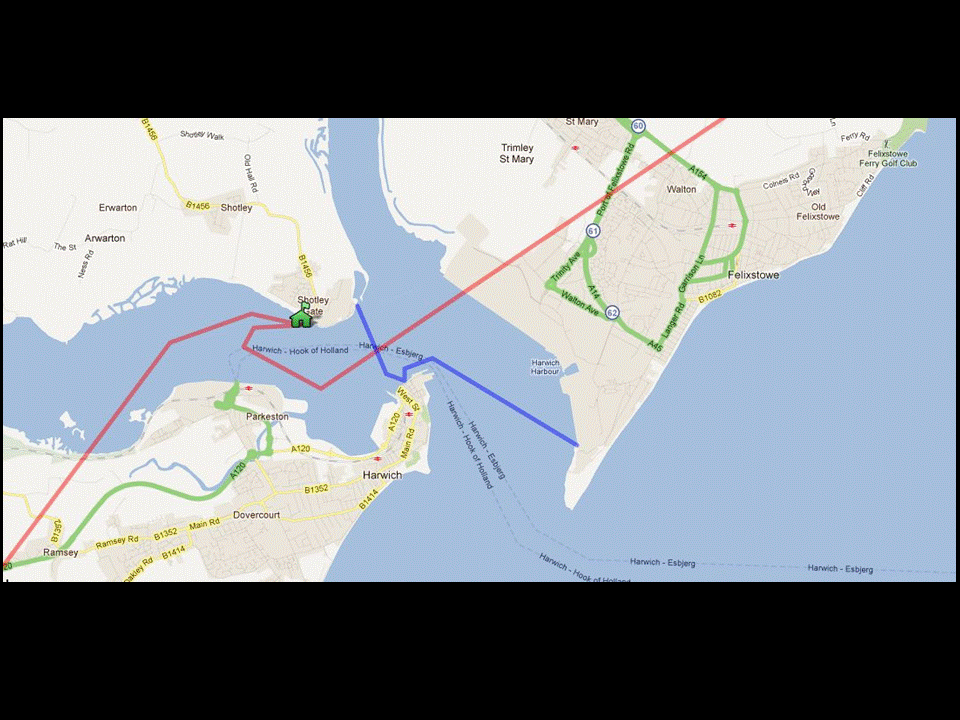
Ipswich has no airport but it sits on a large river, the Orwell. To fly anywhere from around here you need to travel an hour to Stansted or Norwich. If you are fortunate to live near to Norwich, you can ticket to fly to Amsterdam and be flying onto the USA or Asia before anyone can get to Heathrow or Gatwick, your only other choices. A 170 mile hop from Ipswich's waterfront for Amsterdam connections might be attractive for that reason.
Seaplanes are slower than land planes of the same type due to extra drag. The deHavilland Beaver, the most-used seaplane, cruises at 110-120 mph.
Where there is enough land near a place with demand for an airport, there is usually a premium on its price and demand for using it for other development and understandable concerns about noise and safety from the local population. A water landing site generally has much fewer conflicting demands for it and seaplanes can peacefully coexist within harbours and amidst boat traffic. Were it not for some ridiculous regulations that don't exist in the US and Canada, the investment required to establish a seaplane hub in Britain would be a fraction of a new ground airport.
4: Seaplanes are not more fuel efficient. Your blog's table of vehicle carbon outputs doesn't look right. A Beaver consumes 22 gal. of gasoline per hour, for a gas mileage of 5 MPG. This is comparable to a bus or 18-wheel truck.
I don't say they are more fuel efficient. The CO2 table puts a small plane the same CO2 per passenger mile as a train. But it's the total carbon output that matters when you also account for the carbon output of building roads and tracks and stations and airports over the service life. Technological development will make aircraft engines cleaner and more efficient. The development of composite materials is making the aircraft hulls safer, lighter and corrosion-proof.
We also need to be thinking about the environmental cost of building more infrastructure and one solution is to use an abundant and cheap resource i.e. open water over a resource that is scarce and expensive in Britain. Extensive research has shown that hull for hull, seaplanes have less environmental impact on water quality than private sail boats.
In conclusion, to start a viable seaplane service you have to find a route to a place that is not readily reachable by road, has a reasonable amount of high-price tourist or business traffic, and has water available.
I don't know southern England very well, but I would assume that there is no place that can't be reached by road except for islands. This does not eliminate all possibilities—ferry rides to Ireland, France, and the smaller islands can be long, and existing air service does not cover all routes. I hope you work something out, as I'd love to see seaplanes flying in Britain.
Exactly why I suggest a service between London and Suffolk. While there are roads and trains, there is a market for the speed of aircraft travel here. Manhattan and the Hamptons have airports and roads but seaplanes are flying between those destinations for the passengers willing to pay for the convenience of door-to-door service. Seaplanes are unlikely to connect London and Birmingham but the Scilly Isles have lost their helicopter port (to a supermarket) and the ferry takes too long. Seaplane services are developing in Ireland for tourism and as feeders to international flights while some regional airports have closed there and a seaplane service operates from Glasgow to the Scottish Highlands. I have a hunch that Suffolk has similar potential. What I'm pleading for is the powers that be to investigate that hunch with some serious research and clear the present misguided legislation that is the barrier for seaplane investment in the UK.
Thank you for your time to give such a detailed consideration to my proposals.