|
| Southwold Beach |
Southwold is one of England's favourite seaside resorts. Its special character stems from the informal groupings of houses around a series of pleasant greens. Add small museums, pubs and restaurants serving the locally brewed Adnams beer, a sand and shingle beach and a feeling that 'nothing's changed for years' and the appeal is irresistible. Suffolk County Council Tourism Guide 1999~2012

At getting prominence in the national media, Southwold has always punched above its weight. This coastal Suffolk town with a dwindling year-round population that recently slipped under a thousand souls has greatly benefited from the presence of the brewer Adnams in the town. Since 2003 their slogan 'Beer From the Coast' (now like many residents in retirement) and other marketing has used the iconography of Southwold's beaches, fishing boats and lighthouse for its brand identity. The spending power of the brewer plugging its beer has made the Southwold and Adnams name and image synonymous and the envy of any resort with a promotion budget limited by its precept.
 |
| Chris Wormell for Adnams |

There's no doubt high street retailing is in trouble these days, a victim of another industrial revolution, just as the buggy whip maker was dispensed with by the automobilist. Amazon and other online retailers have killed off small independent book stores and big-box retailers - once the scourge of small shops - have become victims of 'showrooming' consumers too. The retailing pundits advise fighting back with services that cannot be bought on-line and urge retailers to move into an experience economy, one where customers buy an overall experience and attributes of the experience provide benefits, beyond product and service benefits.
 |
| weekday hours compared |
Offering an 'experience' of a bygone England is Southwold's stock in trade, though time has not actually stood still here as many icons of its old-world atmosphere are actually a re-enactment. New traditions have been invented and old traditions have disappeared. It's normal entropy.
The townspeople grumbled when Tesco Metro and WH Smith opened branches (the latter filling the void of losing two independent book shops) and clothing boutique chains Aubin & Wills and Fat Face arrived without a murmur but the populace drew a line in the sand (or shingle) when the chain with over 1300 branches acquired premises in June.
Instead of questioning who was the local property owner who sold them down river or asking local estate agents, builders or architects not to facilitate Costa's presence (naturally that would affect local people's livelihoods), public anger was channelled away from the collaborators towards Waveney District Council's planning committee who were described as a rotten noisome corpse when they proved useless to prevent it. I too have also found it brings on opprobrium to question the arguments or motives of the Costa opponents but if they cannot stand my simple examination, they certainly won't stand up to Costa.
I posit that Costa know a good thing when they see it. Though trading conditions for many kinds of business in Southwold are difficult because Summer peaks have to cover Winter troughs and I am told landlords demand a stiff premium in Southwold. A rent of £80,000 p.a. was quoted for one shop and 72 High Street, one half of the contested Costa site, was advertised at £52,250 p.a. But lately Southwold has garnered enough colour supplement exposure to be aspired to by the lower orders that it now gets mentioned in Coronation Street's story lines. Costa must be confident they can capture a slice of the market of thirsty visitors.
According to independent research consultancy Allegra Strategies: 1 in 10 UK adults are now visiting coffee shops daily and the UK sales are predicted reach £3.2 billion by 2015. Coffee will continue to be seen an affordable treat and provide a much needed indulgence for consumers during challenging economic times. Meeting a friend for coffee or getting a cup to-go cannot yet be delivered on-line nor do consumers drive to out of town stores just for a cup of coffee.
One line of reasoning the Southwold Costa objectors have taken is there are enough coffee shops already. They claimed there are 20 food and drink outlets in the centre and 11 on the outskirts that represent almost a quarter of the total number of ground-floor business premises in the town.
“It’s not because it’s some garish chain; it’s because we already have more than enough places to get a hot drink,” Robert Adey, owner of Trinity’s Tea Rooms was widely reported as saying. “If someone had suggested a fish and chip shop, for example, that would be different as we only have one."
Well, I know there are two places I go for fish and chips in Southwold, plus all the pubs who do fish and chips, which rather undermines this position. And while there may be plenty of food and drink on sale, it may not be good coffee or sold in a casual unhurried atmosphere where you can read the papers, log on to update your blog and so on, which is pretty much what Costa offers.
When I heard there was a glut of coffee shops in Southwold I immediately doubted it. So last Friday morning between 9.30 and 10 am, as I had other business in Southwold, I took a perambulation to see what its coffee shops have to offer and how they might serve my needs and how Costa's retail "offer" (see footer) competes or fits into the local market. At that time I wasn't aware that the Southwold and Reydon Society had also compiled a survey of Southwold's coffee shops but have noted discrepancies between us.
 |
| 70 & 72 High Street. Acquired by Gentian to become 50 seat Costa Coffee |
Pub coffee
Like all of Southwold's pubs The Kings Head is an Adnams house. It has a restaurant room facing onto the High Street which is visible when arriving at the bus stop. In the morning of my visit the restaurant looked dark and uninviting. A sign on the door said 'Fire Exit Keep Clear' which made me reconsider: is this the proper front door or not? It doesn't seem be going for the take-away coffee market and whilst all the pubs are very presentable, the offer from them is rather more about food and alcohol and, as this is an old building with narrow doors and varied levels, if I had children in a pushchair with me or my mother in law, I'd probably not go in.
The Lord Nelson menu says it serves coffee but has several rules about children posted outside so this is not one for the buggy brigade. The Red Lion had outside a old Kenco Coffee sign visible from the Market Place. The brand values I associate with Kenco gives the impression that such places serve drip or instant coffee. That actually might suit the 'typical' Southwold resident more, as there is an age gap in coffee drinking. According to a YouGov poll, the over-55s are more likely to drink instant coffee than 18 to 24-year-olds, who prefer cappuccino and lattes.
Hotel coffee
At first I left the Blyth Hotel out of my perambulation because it was out of the area I consider the tourist 'heart' of Southwold High Street and the Southwold and Reydon Society also didn't count it either. Visitors coming by bus will have passed this place a way back. It has tables and chairs outside but it doesn't look like a place to pop in for a java to go. However, from past experience and its present appearance, it looks like a nice place to meet someone for a coffee without a struggle to park.
Similarly Sutherland House, The Swan and The Crown have imposing façades that suggest fine dining, though the outside tables and chairs outside hint at a more casual menu as well but their linen table clothes don't shout casual coffee shop experience or prices. According to the SRS the Sutherland doesn't do take away but the other pubs and restaurants do.
Sit-down coffee
The Adnams Cafe is in the back of Adnams flagship Cellar and Kitchen store with only its signage visible from the High Street so curiosity is required to venture inside. It is a very pleasant space, there are several well designed seating areas and a patio but there weren't any 'to-go' cups stacked by the barista station so I count it as sit down sort of place but SRS say it does do to-go.
For presenting itself as a fancy tea-shop, Tilly's gets top marks but linen table cloths and the compact front of house gave me the impression that ordering to-go would probably meant you were standing in the way of the serving staff. SRS says it doesn't do to-go anyway. Though it has outdoor areas as well, If I went inside with kids and a buggy, I think tut-tutting would ensue (postscript: In March 2013 Tilly's announced that it would close in Southwold and in July reopened in Halesworth taking over the premises of Number 10).
The Lighthouse wasn't open during my visit. The menu gives the impression it is more an eat-in establishment capturing the lunchtime and dinner crowd and it probably doesn't compete directly with its neighbour though the SRS counts it as a to-go. Similarly, though Coasters is very attractive and prominently displays several awards, it again as a 'licensed restuarant' seemed a bit 'up-market' to pop in for a coffee to go. The Beaches and Cream take-away is a couple of doors away but this establishment wasn't counted by the SRS.
Eat-in/Take-away coffee
Trinity's Cafe is bright and open plan tea room on the High Street with big windows so you can see inside what it offers. It wasn't open when I passed it (it opens at 10 am) but it was obvious that it wasn't a fussy sort of place, access for the young or old would be easy and you could see it had a barista station and to-go cups. It is probably very popular.
The steamed up windows and a queue of customers (when other places were closed) and the fancy bread in the window of Fresh Bite promised satisfaction but it did not advertise it served artisanal coffee. The steps and the queue put me off from venturing inside just to ask if they served cappuccinos though I would head straight in for cakes or bread. SRS says it does to-go. Update March 2013: Fresh Bite has reportedly closed.
The promise of the bright and welcoming frontage of Black Olive was explicit: this is a delicatessen with a range of savoury goods. A obvious barista range, bean grinders, blenders and stacks of to-go cups and speciality coffee for sale removed any doubts that a coffee to-go would be prepared with the same dedication as they give to the rest of their cuisine. There is no eat-in.
I missed Squiers the first time around my perambulation. A Southwold institution, I always thought it was a sweet shop and I have purchased sweets from there many times but I am informed by a local and its website they also serve teas and coffee to go. There is a small sign above the shop front saying 'Morning Coffee'. Obviously that failed to make an impression on me. When you venture inside the 350 year old building you find a cozy tea room (capacity 28) with beamed ceilings and an inglelnook. The website doesn't say if it will serves drinks to-go outside of its restaurant hours that are limited to 12 - 2 pm.
On the Market Place the Buckenham coffee shop was signed as such but was closed though I have visited it before. It is down some stairs which makes it off limits to the buggy brigade. You can't tell from the outside if it serves coffee to-go until the staff put the chalk boards up on the railings when it opens though several photographs show they do. I am told by a local resident that this place was popular with many older people in Reydon who would ride the bus to shop in the Co-op and then meet their friends here. Now that the bus cannot go along the High Street, those customers take the bus to Beccles and meet in the Tesco or Morrison's coffee shop. It seems Southwold Town Council is just as capable of killing trade for its establishments as Costa could while dismissing evidence as anecdotal while basing their decisions with nothing more than other anecdotes.
Just about visible off the Market Place is Munchies. The signage and noise of the barista's range plainly promises servings of good coffee and sandwiches to-go or eat-in and I would imagine it catches a bit of footfall of people heading to the beach for the day with the papers. On the other side of the Market Place is Queen Street and Beaches & Cream there was also closed on my perambulation. I actually failed to notice this establishment was a coffee shop (so did SRS) but its website says it serves a wide range of coffee to-go as well as ice cream.
 Adnams Cellar & Kitchen - you can just make out 'cafe' under the awning
 Buckenham - in a basement though when boards up says 'take away'.
 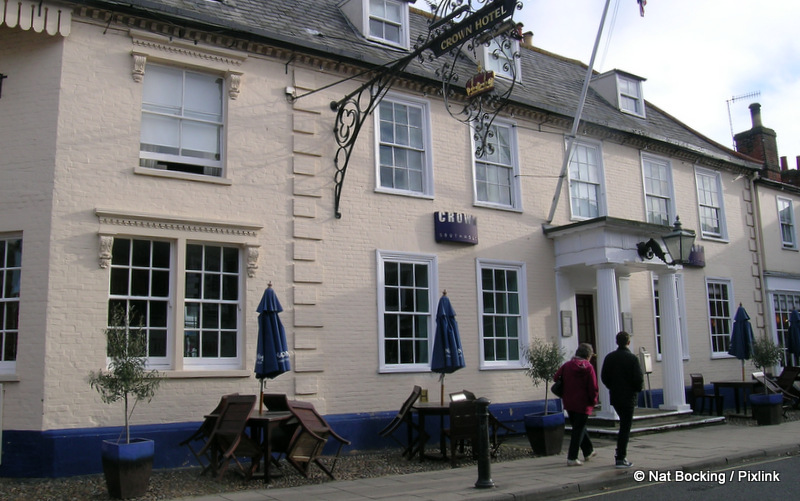 The Crown - lovely for lunch or a pint but not exactly casual
 Fresh Bite - tasty bread and cakes but no sign of a barista
 Kings Head - where is the entrance?
Munchies - bingo, the ideal of a casual coffee shop

Nelson - off the track, no kids in the bar
 Black Olive - coffee jackpot but only to go
 Sutherland - not morning people
 Swan - so charming you won't go in without a tie
 Tillys - now closing
 Trinity's - all three beans in a row
 Coasters - not for lounging with a laptop?
I didn't go as far as down the stairs beyond the Lord Nelson to the sea-front to find Susies Beach Hut but I would consider this kiosk is not competing for for customers with establishments on the High Street. The SRS counted it though it is outside the DM01 designated area. SRS say it doesn't serve to-go.
I missed out of my survey Mark's Fish Shop (also outside of DM01) and the Farmhouse Bakery and Hutson's the butchers. It wasn't apparent to this casual pedestrian that any of these places served coffee. The Southwold and Reydon Society survey hasn't specified what kind of coffee these establishments serve; they could be counting instant granules dumped in a styrofoam cup as equals of an artisanal fresh roasted cappuccino. Most of these establishments make no mention of serving coffee on their websites or in local directories which today's wired traveller might casually browse on their smartphones. The Southwold Chamber of Commerce only lists two cafes in its guide that visitors pick up.

In my perambulation I found 19 establishments that I could identify as likely serving coffee in the vicinity of the High Street but not all were open in that morning nor fit my needs or wants. Only two pubs open before ten and only two of the four restaurants open before lunchtime, three close during the afternoon and all make exhortations to book in the evenings so I doubt they'd entertain a casual coffee drinker at peak times. By 5.30 most of the establishments serving any hot drinks have closed leaving only eight open with only one of them, the fish and chip shop, in the casual dining category. At 9.30 am I had only found four establishments that were serving good coffee in a casual surroundings but only one of them, Munchies, made that offer obvious to the customer on the street. It's no wonder chains succeed by the power of their brand.
Addendum: The Two Magpies Bakery opened on 3/4/13 in the high street offering artisan breads and coffee.
Therefore the saturation argument plainly, ahem, doesn't hold water. Costa does not offer linen table cloths, dainties on cake stands or the ambiance of the classic English tea room which Southwold has an abundance of. A trawl through Trip Advisor shows some of these outlets could also do better at customer service, though I've never encountered myself rude or condescending service that has been claimed. I note that a commenter on the EADT website also rips the SRS survey to shreds.
The variety of Southwold's coffee market is like a microcosm of Britain before the arrival of Starbucks in the 1990's when a coffee shop visit was a hit and miss affair. The many Italian establishments famous in Soho and the 'Milk' bars of the fifties and sixties were disappearing under fast-food franchises. The only social space on the high street apart from the pub was the greasy spoon where unless you drank tea, your coffee was instant muck but health awareness was increasing the demand for alcohol-free and smoke-free environments and less greasy snacks. The Seattle Coffee Co paved the way reaching 50 stores before Starbucks bought it so it could hit the ground running. Now we are seeing university bars being shut to be replaced by coffee shops. While the chains have 5,000 shops in the UK, there are 6,000 independents and they too are benefiting from a rising coffee culture.
There is a case for saying Southwold needs more coffee shops as these can generate footfall in town centres. There is a symbiosis between shops and cafes: if there is a good retail offer in a town, shoppers will visit and when their feet are tired, they will stop in for a coffee and meet friends and are then more likely to return. Similarly, if there is a good offer of 'social places', they will visit them and may be tempted to shop for goods and services nearby but neither is much good without the other. Costa has several corporate franchise partners such as Next Home + Garden offering Costa coffee shops within their stores.
 |
 |
| Four very recent shop sales were all bought by one developer |
Whilst large chains have advantages on costs because of their scale, the independents can be more flexible and agile and get to know their customer. I don't know them personally but I know the owner of Munchies is a local person married to the owner of a local wine shop so I know the pounds I spend in there will then go out the door to local people who work there. It might be an idea for Southwold to consider what towns like Brixton, Lewes, Stroud, Bristol and Totnes (incidentally all except Totnes have chain and independent coffee shops) have done and establish a Southwold 'pound' to keep the spending local.
The other line of reasoning taken by the objectors is that the presence of Costa undermines local businesses. Guy Mitchell, chairman of the chamber of trade, and Michael Rowan-Robinson, chairman of the Southwold and Reydon Society jointly said “[We] will be opposing this... which we believe poses a very real threat to the unique character of Southwold High Street and to the viability of other local shops."
 |
| Michael Palin |
I can't find an economist or a politician except on the far right lately reasoning for economic protectionism unless we have a Soviet planned economy. Only in the village of Laycock which is owned by the National Trust could such control be exerted. Protectionism props up failure and inefficiency and stifles innovation. The British Independent Retailers Association doesn't advocate protectionism; it knows you cannot stop people voting with their feet. It suggests that retailers smarten up their shops, revitalise their products, train their staff to treat customers fairly, and encourage customers to 'click and collect'. The biggest threat it sees are not chains but the three Ps - planning, parking and property taxes.
Revision 29.3.13
 |
| report of Tilly's closure 29.3.13 |
The closure of Tilly's Tea Room has been reported in the Lowestoft Journal where the owner blames the chains moving into Southwold for forcing up the cost of premises. The terms the landlord offered at her renewal required a 10 year lease, and given that she was "on the wrong side of 50", she decided to close instead. The statement is a whip on the spinning top of "all chains bad" mantra of the #shoplocal activists but if an less-ethical business A will pay a higher rent than a more-ethical biz B; surely it's the landlord's ethics that should be challenged too and ultimately blamed for letting to A. Offering temptation of selfish gain is one sin, yielding to it is another.
 |
| Hard to believe but there is deprivation in Southwold |
 |
| George Orwell's house in Southwold |
People have demanded that chains should be prevented from trading in Southwold as they dilute Southwold's uniqueness and apartness from any other towns. However, that first begs a question what size defines a chain and would they like to ban banks, petrol stations and pubs that are all chains too? An idea was advanced that only locally owned shops should be allowed. Such reasoning is oblivious that franchises such as McDonalds are actually independent local businesses too.
Bans on 'formula businesses' has been enacted in thirty communities across the USA to protect the unique identity of towns causing no end of legal challenges though most have not been sustained. Southwold ought to examine these formula business laws to see if any models can be shoehorned into English law. Some challenges were upheld (in most simplistic terms) because US commerce law guarantees certain freedoms to trade. A ray of hope for Southwold could be the new Localism Act of 2011 and the Community Right to Bid. If Southwold Town Council were to register a community interest on every shop or commercial property, then at least it would have first refusal on buying them or taking them over themselves if they came on the market or their occupants threatened to close.
I rather think that Southwold's uniqueness is more made of a lighthouse in its midst, the brewer's horses (oh, those have gone) and the Georgian architecture, which is much more durable than the attrition of shop proprietors, and this uniqueness is very much a construction of the brewer and other tourism interests; the hotels, the pier, the lettings agencies etc., over the last twenty years to position Southwold as a brand apart.
Southwold is not really a town any longer (I can hear the bristling from here) but a resort. Though granted an ancient charter, a local landowner's embankments caused the river and harbour to silt up and by the 1880's it was another depressed fishing village until it was developed by a single company who built hotels, a pier and installed electricity to attract the wealthy to holiday by the sea. Though its fortunes have fallen and risen, it's economic heart hasn't changed much since then. So at the heart of this I think is really a brand war: the conflict between the strength of Costa's brand that could dilute that of Southwold's. So we ought to also look at Southwold's brand values and ask ourselves: whose are they and are they really worth defending? Why are we being called to arms and who will get the spoils of victory? I'm not yet convinced that they will be be shared with everyone or be worth the cost.
For better or worse, Southwold, like its coastal neighbour and rival Aldeburgh, has positioned itself as the place for the "discerning" visitor, which is marketing-speak for rich. This coffee war has elements of class-war and mutual class hatred. An upper-class brand is pitted against a populist brand. The disdain for the ubiquity of Costa is perhaps because there is a lot more of the poor than the rich. To detract from Southwold's uniqueness is to tarnish its brand values as an exclusive playground, which in turn decreases the value of the second homes, the rents for the shops and the prices charged for goods in them. I suspect if there were more casual, 'social space' coffee shops instead of pubs, that might attract more of the less well-heeled traveller, the backpacker, the cyclist, the bus rider and heaven forbid families who can't buy what's in the boutiques or have £75 for lunch but still have a right to park, piss and potter about. Southwold has been accused of snobbery - or should it be put as a wish to maintain an exclusiveness - but I wouldn't accuse the townspeople as a whole of being snobs but some of the visitors are and I dare say some of the generals leading the battle are self-appointed guardians of what is their own particular vision and vested interests in the town. I wonder where they think further economic growth in Southwold will come from, as all capitalist ventures need growth in either demand or market share, where the latter naturally comes at the price of someone else's assets or amenities.
The Costa opponents say they want to keep Southwold's businesses locally owned and it's quite true that local ownership has local benefits. A giant chain has economies of scale in physical resources and manpower that reduce its costs so it generally employs less people and buys more materials and other services from outside the area. We have learned that the coffee chain Starbucks makes a lousy tax contribution to our national exchequer whilst Costa's is much better. In comparing independent grocery cooperatives with chain supermarkets the USA (I could only find US figures) an independent had twice as many employees per million of turnover yet the co-ops were no less profitable or less viable, it's just a different distribution of the profits. With an independent, the costs eating up the profit margin are benefits going to the employees rather than shareholders. Chain stores owned by large corporations are run by distant boardrooms with little knowledge or concern for local issues. It's my personal experience that local independents are far more generous to local charities or community organisations. If you ask them for raffle prizes they are likely hand you an item of slow-moving stock right off the shelf whereas chains (except notably Adnams and the Co-op) direct you to a faceless functionary who makes a paltry offer of 2 for 1 gift vouchers weeks later.
However, coffee shops don't source their beans locally neither do many chains source their food from local farmers which independents might but in reality many independents buy their butter, bacon and milk from Makro or Booker like everyone else. I doubt any of these local businesses owners would really sacrifice their profits and their personal pension pot to hold onto surplus non-family employees if they could run their business just as profitably with less staff. As far as I know only one business in Southwold is a co-op (and the organisation of the weekly produce market is cooperatively run). None of the locals have proposed forming a co-operative cafe to create local jobs, or even to provide training for young people, like Jamie Oliver's 'Fifteen' concept.
No establishment has a right to protection to serve insipid or expensive food and drink. If the customer wants good affordable coffee served in suitable surroundings and isn't finding it, the theory goes that the market will respond to meet the consumers' needs or the customer will go elsewhere. It also stands to reason that the wider the retail choices the customer has in a given place, the more likely the customer will return to shop in that area and so everyone will benefit.
A good range of food and drink in Southwold will benefit the clothing boutiques, the grocer, the music and card shop as well. Southwold's economy is already 'hollowed out', there are either low-skilled, low-wage jobs or a few professional positions but very little relative opportunity for skilled people to make an above average income. Some creative people and businesses have recently moved to Southwold but any local clients are in the tourism sector. Southwold's economy is wholly dependent on the visitor, the wages of the locals can't buy what's in most of its shops. The retained firemen can't afford to live in the town, affecting their response times. The volunteer 'First Responders' plead for more people to volunteer with them but the base population of able people in the town is just too small. Coffee shops are labour intensive and so create local jobs which are scarce in Suffolk, I think young people locally will be thankful for Costa's investment.
Should a Southwold business grow so big, would we demand brakes on its growth? What if Adnams grew as big as Whitbread? Costa was started in 1971 by a pair of brothers who obsessed about roasting coffee to achieve better flavours. Coffee shops beat a path to their door to get a better product than they could find elsewhere.
The opponents of Costa ought to examine closely the niche they think that Costa wants to fill and see what they or Southwold can do better. Costa is a threat to other Southwold establishments because it makes a very explicit offer to the customer as to what it sells and as I have shown, some of Southwold's businesses fail miserably at doing that. But like any other business, Costa too has to compete for the customer with everyone else. Southwold's establishments can counter Costa by making a better offer. That's the promise of capitalism we're sold. It's through capitalism that people make a killing to buy their second homes in this quaint paradise that these businesses depend on.
I am actually quite pleased that Costa hasn't had an easy ride of this. I hope the resistance has shone a spotlight on the concept of Corporate Social Responsibility for all parties. Starbucks and McDonalds have in certain situations 'de branded' their store fronts so you have to look hard to identify they are a chain. Tesco have established a "family" brand of coffee shops called Harris + Hoole. If Southwold could enforce the wolf to wear sheep's clothing, it would still appear as if "nothing has changed" in Southwold and their façade would be no more disingenuous than the rest of the story.

This is Costa's retail 'offer' from their website to potential franchisees. How do Southwold's coffee houses match this?
Shop Design
Our property team will work closely with you on the design and build of your Costa coffee shop, ensuring that you create the welcoming environment that Costa is known for. Our iconic counter design, relaxing seating areas, soft lighting, modern decor and branded external facia will ensure that your store provides the reassuring ambience that Costa customers have come to expect.
Costa Coffee
Our Costa corporate franchises offer all the authentic speciality tastes that have become so popular today. These include cappuccino, caffe latte, americano, mocha, hot chocolate and the hugely successful coffee lovers’ favourite – Flat White. Our new lower calorie beverage, Costa Light, is also proving a big hit with customers who like to enjoy a lighter coffee.
Food Range
Our delicious sweet and savoury food range is the perfect accompaniment to Costa coffee and our products are segmented to maximise each day-part opportunity – adding value to your coffee menu and generating additional transaction sales.
Start the day
Your customers can start the day with one of our mouth-watering breakfast treats; granola topped yoghurts, popular toasties, danish pastries or enjoy our fabulous all day breakfast roll.
Lunch time favourites
Think lunch, think Costa! Customers will be spoilt for choice with our lunch range including signature rolls, sandwiches and mouth watering paninis. Health conscious customers can also enjoy a fruity dessert or for those with a sweet tooth, our delicious cake range is second to none!
Carefully sourced, lovingly created
We know that the origin and source of meat is an indication of trust and quality to our customers. We also have the desire to source more locally produced produce and support British agricultural producers. Our poultry, pork and beef is sourced from British farms and we only offer free range eggs in all savoury products – another great reason for your customers to enjoy Costa food.