 |
| Montana: Sandie on a Honda Dream with her 62 Pontiac convertible. |
This is a photo from an album I found lying in the street in Venice California around 1992. The album was begun by an unnamed woman who lived in a modest housing development in Los Angeles. She is married to always smiling man called Bob and she has just had her first child, born around May 1965 I am pretty sure.
Once I'd dried the album and the loose photos - its covers had been ripped from it - I filed it away with the California ephemera I've collected from thrift stores and yard sales. Once in a while I used to take the album down and look at the photographs to see if any new clues about who it belonged to would come to me.
Until very recently the internet didn't yield anything and I didn't have the means to scan pictures to send to them to people. Also it wasn't a project I was devoted to, I have plenty of other things to do, but the album and the story of how I found it was a story I sometimes told my friends with an interest and knowledge of California and we considered it an artefact of urban archaeology. Its provenance assured us this was an honest and artless account of the life of a suburban housewife at a turbulent time in American history.
A few years after this I started my own family and we began making our own albums and so I would think of Sandie and what the loss of such a family album might mean. My partner was there when I found the album and recalls there were clothes and all kinds of trash strewn in the street, as if someone had been turned out of an apartment or had just thrown everything in a dumpster - which being in Venice, the many homeless people there would have rooted through and scattered in a second. Her concerns echoed mine: nobody throws away a family album, something bad might have happened. I am not so pessimistic it was because of a tragedy. Venice is a wild, bohemian and transient kind of place. People can get mixed up in things there. Even good people can get ill, which can lead to debts, and landlords can be pretty brutal if you get behind with the rent.
Sandie's photo journal tells us she went to a parade in Hawthorne CA, to Disneyland with her girlfriends, there were celebrations of Christmas and Thanksgiving and vacations in Montana, visiting the family farm of her in-laws which includes a log cabin an ancestor built. Bob can water ski, he likes to keep fit with weights. They look to me like a hard working blue-collar family; Bob's shirt sometimes has a plastic pocket protector with a logo (too blurred to read) and he only wears a tie for church so a wild guess would be he worked in the defence industry or space programme. He takes the head gasket off the car without that look of despair there would be when something is broken, so I guess she took a picture because she is proud her man is handy with tools.
She evidently dotes on her baby daughter and seems blissfully happy making a home for her family and she enjoys her casual social life of barbecues around their backyard fire pit, noting the minutiae of her life and of her friend or sister Carol with funny captions in white paint onto black sugar paper with a neat cursive hand. She and Bob are attendants at the wedding of Butch and Elaine which seemed a modest affair with a casual buffet rather than sit-down catering. Butch is in a US Army uniform and Elaine seems very young, though plenty of people married right out of high school back then. Perhaps he had enlisted or was drafted, that was really going at the time, and so they got married before he went to Vietnam? He looks tanned so perhaps he was on leave after basic training? He resembles Bob a bit so he could be a brother or cousin. Money was probably tight at times; the Christmas presents aren't extravagant. Her "birthday and Christmas present all rolled into one" is new furniture.
The story ends when the last pages of the album are filled with colour film and the arrival of another child around September 1967. Why then, some twenty years later, does this happy family album end up torn and waterlogged in the road? I scooped many photos off the street being scattered by the wind; so many captions are for missing photos and with some photos it's hard to work out where they really belong.
Every photograph invites us to construct a narrative. Based on these characters and their adventures in the album I can construct my narrative of their lives and project it into the future and I suppose someone else would construct another. Most of the people are given first names in the album except the author, so we used to call her "Barb" because it sounded right; their friends would have called them 'Bob 'n Barb'.
In the intervening years I travelled a lot in California and visited Montana and South Dakota, spending months in Rapid City working on a movie about Wounded Knee and I came to love the place and the people. It’s amazing with what little information you can identify something when you know something well. Just a fragment of the profile of a hill or road can be recognised IF you know it. The archaeologist can identify the whole pot just from the broken sherd because every curve is familiar to them.
Something that intrigued everyone who read Sandie's book was what did she leave out of her story? Is there any relevance on how she is telling her story now? I don't suggest anything sinister; it's just that all truth is mediated and manipulated by the author. What do we leave in and leave out and how does time filter and mediate that too? These are topics people can write PhDs on. This suggests to me an interesting idea for a film. With the freedom to invent dialogue but constrained to use exactly the same cast, props, and locations, and if every version had to share the same photographs, what stories could a variety of writers tell?
I have found other albums and identified their subjects before but I haven't yet reunited them though I've tried and spent time and money on it. I have also reunited people lost to each other for sixty years. This distant life of Bob and Sandie is rich and interesting and our relationship is perhaps just as real and strong as if I had really known them all along. I have hundreds of pages of my late father's writings and the sheer density of the information cries out for a few more photographs to construct the missing context and narrative for them.
The eldest child must be mid-forties now. A possible clue to her unusual name was that it was a character in Dr. Zhivago and the film was released in 1965. It's a slight coincidence that my late sister was called the same name, so I understand the appeal of her mom giving her an exotic Russian name. It would be quite interesting to trace them. I can only extract a few clues and I've given most of them here but I don't have the time to follow them. Some people do though so I thought I would enlist them.
Having watched the FBI do it, a law enforcement officer could search the title histories of the cars in the album to establish a few leads. It's amazing how much narrative is encapsulated in six or seven letters of a license plate. I think the Pontiac convertible is California LIZ 355. I doubt it can be done by the public through the DMV as that would be an invasion of privacy.
The kid's names are unusual and the birthdates are pretty
clear, their mom gives their ages in months with the date of some photos so it would be one month either way. I don't have access to the California Birth
Index because you have to pay for it but some libraries do. Given the number of family photos taken in Montana, the children could have been born in Montana. If her mother is from there, she would probably want to be around family for the support with their first newborn.
I can't recall exactly when I found this album. I lived in Los Angeles from 1983 to 1999 and in Venice from
1985 to 1993 and I recall I found this album towards the end of 1992.
I have posted this blog entry so I can link emails to it and make some enquiries. It might make a nice Christmas present if I can find this family.
I have posted this blog entry so I can link emails to it and make some enquiries. It might make a nice Christmas present if I can find this family.
--
John Baker of Hawthorne's Cougartown website has offered to help out. However there's no hard evidence this family lived in Hawthorne except the parade photos. It could turn out they just visited friends or relatives there. I've looked very hard for local clues, any street sign or a house number but I don't see any. The front garden is identical to many thousand others. I think they rented an apartment at one time because early on Bob snaps a pregnant Sandie sitting on the car in front of a group of garages where a sign says "no car washing or ball playing". A newspaper a baby is holding in one picture in the back yard is definitely the Los Angeles Times of July 1965. The parade photos were taken on the corner of 132nd Street and Hawthorne Blvd. outside Green Farms Barbecue which apparently was then owned by a Sid Schwartz and had a huge rotisserie in the window. It's gone now but amazingly Phil's Bike Shop a couple doors down is still there. Did they buy the Murray pedal car there? List price was $26 back then.
 |
| May 1968: Murray Fireball Pedal Car with 66 Buick Skylark |
 |
| "Me" May 1968 |
 |
| March 1968 - Bob |
 |
| Bob - Butch - Elaine - Me November 1966 |
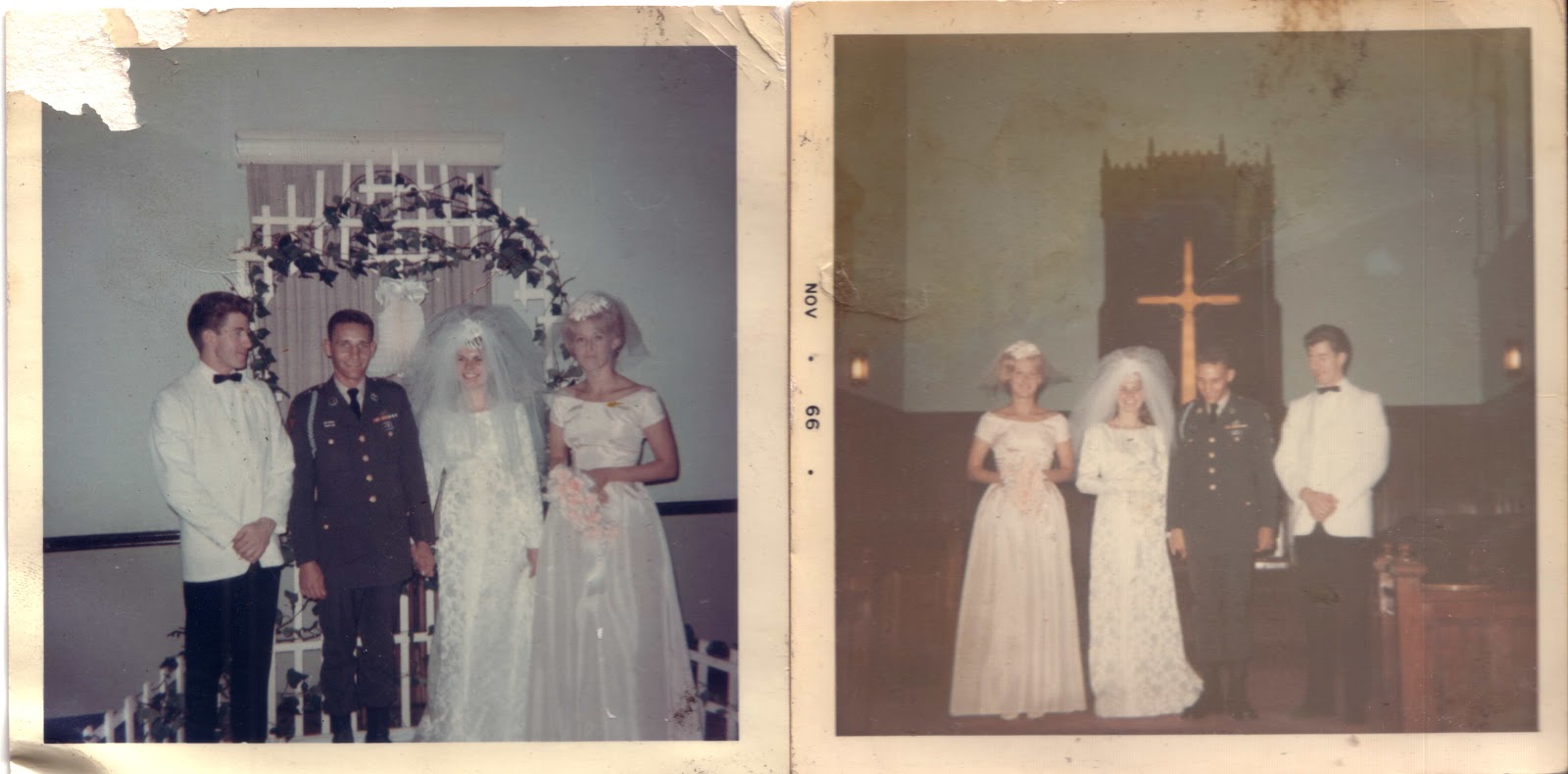 |
| Butch & Elaine wedding November 1966 |
 |
| Eddings Bros - Parade on Hawthorne Blvd possibly 1967-68 |
 |
| August 13, 1966 |
Since I first posted this blog entry and made some enquiries, I have had a few leads from people familiar with Montana. And that inspired me to peel off a few photos to look at the back. All of them are blank but one colour
photo was a different format to the others (I've cropped it) and it was of the family seen on fishing trips in Montana in the album. Lo and behold, on the back it says 'Bob &
Sandie' as if someone might have written that on the back to send it to them as
Bob and 'Sandie' are not in the photo. So I think it's a pretty likely that "Barb" is actually a Sandie.
Some more clues:
Sandie is really a brunette. After the birth of her child she goes blond. I guess the chemicals weren't too good for you. Carol also changes her hair colour.
There's a child relative who is five years older than Sandie's eldest who has many individual photos. Bob is about 15 years older than his nephew Zane who is pictured with him at an ancestor's log cabin in Montana. She and Zane are grouped like a family photo with people called Monte and Alice taken at a modest rural house (it has unpaved roads) in Montana just before Bob and Sandie were leaving to go back to California. Monte looks ten years older than Bob and is dressed for ranch work.
Her best friends or sisters are Carol and Diane and they turn up at every party. Jack and Nancy gave a birthday party for Bob. The following year, if the album is in chronological order, Bob had another summertime birthday party which was a luau that Sandie took a lot of trouble to decorate for.
Carol might be Carol Jean.
One grandfather could live in South Dakota, from the newspaper he's reading while fishing.
One grandfather could live in South Dakota, from the newspaper he's reading while fishing.
In most of the photos the car they have is a white 62 Pontiac convertible. Only in the end of the book is one photo of the Buick Skylark. It might not be theirs but if you were proud of your cute kids and their new red pedal car, you might put them in front of Dad's big red car too.
According to a caption to a missing photo Bob drives a truck. No indication if it's a pickup or a work truck.
Anita and Larry are around the same age and lived in Great Falls, Montana and had a small ski-boat around 1965 registration MT720APD. Bob and Sandie and the extended family went fishing and water skiing with them.
I'm working on the leads in Montana, given the sparse population it's a lot easier to check records there. I could put more pictures up but for now I think this is what's acceptable considering there may be a wish for privacy. Until we know, we don't know.
--
I think I've found them. I got in touch with Scott Thompson, the city editor of the Great Falls Tribune in Montana. I've always maintained that if you can't afford a P.I., ask an experienced journalist. He gave me a clue from a license plate (not listed here) on where to look. I'm afraid I can't say more than that just at the moment.
The trail runs cold a decade ago but there's a very good chance that relatives of Bob and Sandie are still living in Montana. All the names in the album, although most of my suppositions of their relationships were wrong, can be tied together in a small county. You only need to know the right county and the right state and google will find them, so I'm omitting how I tracked them down but it wasn't possible until very recently.
Of course, these people forever young in the album must be nearing their 70's now. Bob's parents - if my hypothesis is correct - have died but my conscience is clear I would never have found them before now.
At this point I need to go back and check all my facts carefully before I contact them. I don't want to cause any upset if there's an unhappy explanation or get the wrong people. Sometimes people want to shed their past. My poking around may have already alerted them already so they might choose to contact me or may at least be prepared for my call.
--
Through the Cougartown pages I was contacted by genealogist Denise Spurlock of Ancestral Trees Research who very kindly looked some things up. Her confirming of names has been a great help and it looks as if I am on the right track.
Robert and Sandra were married in 1964 in Los Angeles County. Their daughter was born in April 1965 in Los Angeles County. Another daughter was born August 1967 also in LA County.
--
I think I've found them. I got in touch with Scott Thompson, the city editor of the Great Falls Tribune in Montana. I've always maintained that if you can't afford a P.I., ask an experienced journalist. He gave me a clue from a license plate (not listed here) on where to look. I'm afraid I can't say more than that just at the moment.
The trail runs cold a decade ago but there's a very good chance that relatives of Bob and Sandie are still living in Montana. All the names in the album, although most of my suppositions of their relationships were wrong, can be tied together in a small county. You only need to know the right county and the right state and google will find them, so I'm omitting how I tracked them down but it wasn't possible until very recently.
Of course, these people forever young in the album must be nearing their 70's now. Bob's parents - if my hypothesis is correct - have died but my conscience is clear I would never have found them before now.
At this point I need to go back and check all my facts carefully before I contact them. I don't want to cause any upset if there's an unhappy explanation or get the wrong people. Sometimes people want to shed their past. My poking around may have already alerted them already so they might choose to contact me or may at least be prepared for my call.
--
Through the Cougartown pages I was contacted by genealogist Denise Spurlock of Ancestral Trees Research who very kindly looked some things up. Her confirming of names has been a great help and it looks as if I am on the right track.
Robert and Sandra were married in 1964 in Los Angeles County. Their daughter was born in April 1965 in Los Angeles County. Another daughter was born August 1967 also in LA County.
--
I've rung Robert and Sandie's and Larry and Anita's phone numbers that I could find but they don't work. It may be the directory I've used, they're from those 'People Finder' websites that offer tantalising promises of results after signing up to monthly billing which I can't really justify. The youngest child seems to have married and I rang her number in California in the White Pages and left a message with my email. Ringing people at random from the UK is expensive and the time zone is all wrong. I'm eight to five hours ahead. I am asleep by the evening in the USA when you would likely catch someone home.
Sifting the messy information from the white pages I have managed to find them on Facebook. I can establish all the same connections I had made before, so I've just emailed the youngest daughter. I hope the family are comfortable with talking to me. Anything that's said in confidence will remain so. It's just impossible to enlist help without putting it here in public.
--
I am sorry to hear from him that Sandra has passed away. This became something I suspected when I located her daughters on Facebook and while the still smiling Bob was referenced by both his daughters and his now grown nephew Zane, there was no images or mention of Sandra in their timelines.
I would never have found that out until now as their online presence is fairly recent.
--
The youngest daughter (and later her sister) have been in touch with me.
I have the right people. They're amazed and confused and don't know how the album ended up in Venice. She didn't know it existed. She fills me in on the story;
After his retirement her mother and father had moved to Las Vegas, Nevada. Her mother Sandra passed away in 2007 from throat cancer but her father now lives back in Montana. It's been an interesting forty years.
Sandie was from Toledo, Ohio and moved to California when she was 14. She has one surviving sister who is the Carol Jean in the album.
Sandie was a cosmetologist. She was extremely active in local programs for the education of children. She was the president of the PTA. Bob had worked for the retail clerks union since he was about 23. He retired from the grocery store business about four years before Sandie died. Sandie was sick for many years and he was devoted to her and kept journals of every single day of her care. He documented what she ate, how much she weighed and when she took her medications and whether or not she went to the bathroom that day. Sandie was Bob's first and only love.
Of five children, Bob was his mother's favourite, even though parents are not supposed to have favourites. He was extremely active in school. He played football, basketball, track and wrestling. He lettered in all four sports. He was in the band and played the trumpet and was quite admired by many girls. He was an artist for the yearbook. After graduation with only $20 dollars in his pocket he set out on his motorcycle and rode all the way to California. His older brother had a tire business and he began to work for him. This is how he met Sandie's brother. He was later introduced Sandie while she was out to dinner with her parents, it was just before Thanksgiving. When her Sandie first laid eyes upon her Bob, she told her mother; "I am going to marry that man". Her mother told her she was being silly and that she barely knew him. I was right about the hair dye. When Sandie was 14 she had scarlet fever. She was born a blond but her hair turned black. From then on she dyed it.
Bob now owns a small ranch and raises cattle. He's still close to his nephew who also ranches. He works part time in Las Vegas as an entertainer (of a sort) where he still keeps a second home. His daughter says her dad is a dreamer that succeeded at most of the ventures that he attempted.
I'd love to hear Bob's story. He knows I have found his album but he hasn't responded yet. He's probably very concerned about who I am and why I am interested in him. He may wish to be private but he doesn't seem to be the taciturn sort. I have also made contact with the elder daughter. She works in Las Vegas. I could be touching on times she'd rather forget but they are behind her now.
People's efforts to preserve the memory of their ancestors and put their family history online has ensured I can return the many photos of Robert's parents and his late wife Sandra to their heirs.
There are many social, ethical and spiritual dimensions to this story which I have yet to explore and may want to discourse on later. While such curiosity has uncovered sadness, it has also uncovered joy and it has only been by waking people's curiosity that any progress was made.
It is not trite nor too sentimental to say that the spirits of those we loved that have departed our lives have guided us here.
It is not trite nor too sentimental to say that the spirits of those we loved that have departed our lives have guided us here.
--
Related story
How The Internet Helped One Photograper Find a Mystery Couple Using Only Old Slides
Read more at http://petapixel.com/2013/05/27/how-some-old-slides-led-one-photog-on-a-digital-search-for-harry-and-edna/#Ozt5pVULpvjhPDdd.99
Read more at http://petapixel.com/2013/05/27/how-some-old-slides-led-one-photog-on-a-digital-search-for-harry-and-edna/#Ozt5pVULpvjhPDdd.99
p.s. Please don't lift any images from here for your blogs etc. These are not my images.


