Showing posts with label balloons. Show all posts

Friday, 8 March 2013

Breaking the cycle of harm


I saw a balloon release story in yet another regional newspaper today.

A balloon release story is an evergreen staple of the national and regional media. If there are hundreds reported in online editions every year for good causes, in all likelihood there are thousands of them occurring in the UK. They are increasingly popular at weddings and charity fundraising events as well as memorials.

I must point you to photographs of my beaches in Suffolk as to why I object to any balloon release.

As a journalist myself, I have begun to ask journalists to report balloon releases accurately for what they are: simple littering. Balloon release reports rarely mention their impact on the environment. Any mention of impact is usually a reassurance they are harmless, often quoting a balloon vendor or their proxy the event organiser. In ideal conditions a single natural latex balloon will eventually decay but 'ideal' is not the same as 'always' and releases are rarely limited to a single balloon without tags, plastic ties or strings. It's another tragedy of the commons where each person justifies it by "just one won't hurt".

Balloon releases are mainly done for publicity. They are a photogenic story but, in general, the print and television news media is totally negligent in reporting the harm that they cause or even questioning their impact.
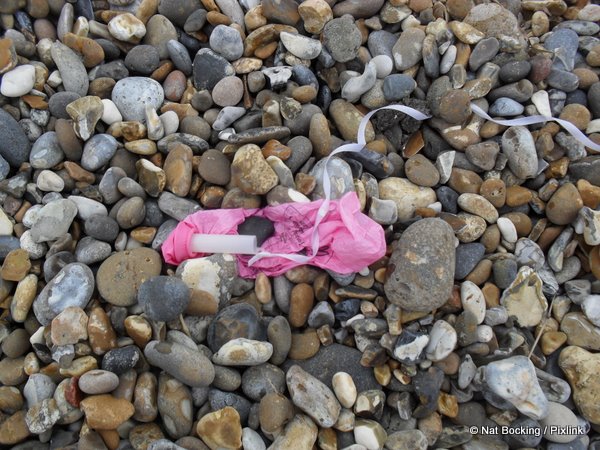

Balloon litter found on Dunwich Beach

Mainstream media has many responsibilities; the most paramount is to be fair, balanced and report the truth. It should not give balloon release organisers encouragement by advance or post-event publicity without at least reporting the harm they cause. This cycle of harm must be broken.

Every year there are thousands and thousands of balloon releases world-wide that were encouraged by every previous release and the photographs published in the media show the vast majority do not adhere to the balloon industry guidelines to only use latex balloons without any strings or tags. The very premise of the popular fundraising method of balloon races requires a tag on every balloon though. Every so-called "responsible" balloon release will spawn hundreds of much more harmful imitators. The general public cannot be trusted to observe release guidelines. The balloon industry cannot be relied on to impose them. In every society its moral standards sink to the limit of enforcement. What would our roads be like if our speed limits were merely guidelines?

Mylar balloon litter found in Suffolk

Sometimes balloon releases are done as a memorial for a dead person, sometimes in tragic cases of children dying. A private expression of grief in this way is ill advised but is generally respected but memorial organisers often seek publicity for their memorials which only leads to more such releases. 

People seek publicity for various reasons. Good causes usually want to raise awareness of their particular cause with a  wider public. Balloon releases are cheap to to organise and seem to walk into content-hungry regional media without question. To approach people who plan and promote memorial releases after their announcement is very difficult. In my experience it's quite safe to generalise that they perceive even the most polite request as being insensitive to their grief. Should harmful expressions of grieving be permitted regardless? Is this suttee of wildlife and livestock and trashing of places of natural beauty acceptable? 
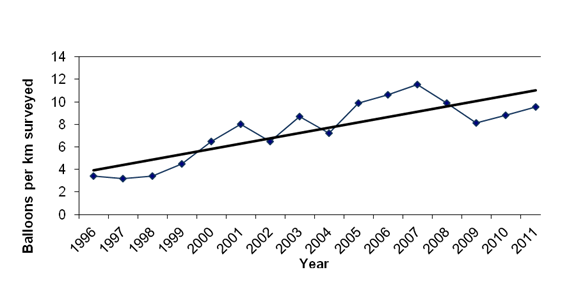
density per km of balloon litter on Beachwatch surveys since 1996

Otherwise celebrities like Jeff Brazier shall continue to encourage his 35,000 twitter followers and readers on the Huffington Post blog to join him in releasing thousands of balloons in memory of Jade Goody planned for March 17th 2013. This is not private grieving and it demands a response that it is irresponsible. His particular (and not unusual) response is to block people who contact him on twitter politely asking him to reconsider.

Balloon releases need pre-emptive information to discourage them. That won't come from the balloon sellers. It won't come from local government who don't require any licenses to release balloons. It could come from the media who can either refuse to run the story or it could respond with "thank you for your submission but we don't promote littering and will report it as such when it happens".


anti litter campaigns are undermined by balloon releases

The defence of releases that the balloons are biodegradable is a myth, put out by the balloon industry obviously to protect their interests. The great number of "turn-up" releases usually include Mylar balloons which are indestructible. But all this is beside the point. Balloon releases are simply littering. If people can be issued with Fixed Penalty Notices for dropping biodegradable fast food or similar litter, how is it permissible to allow and promote littering by balloon releases? Why does the unacceptable disposing of something by dropping on the ground become acceptable by filling it with lighter-than-air gas and releasing it to fall to the ground later?

The legality of balloon releases is subject to debate. The law seems pretty clear that to "otherwise deposit" material is littering but enforcement is very selective. The Metropolitan Police chose not to determine that Lord Coe was littering when he released thousands of balloons to open the Olympic Stadium in May 2012, but whether something is legal, or quasi legal, it doesn't follow it is also acceptable. It used to be legal for a man to beat his wife or to send children into coal mines. Society seems to have a collective blindness to the implications of releasing TONNES of latex and plastic into the air every year in the UK to come down on water and land to leave an unsightly and dangerous mess.

Another menace; the litter from a Chinese lantern
A good number of organisations can provide scientific evidence of the harm of balloons being released, which is far from limited to latex balloons. The RSPCA, National Farmers Union and anti-litter organisations have published guidance asking people not to release balloons. But whatever the scientific argument is, it's just a red herring. The simple fact remains, to let a balloon go deliberately is just littering. No good cause can justify that harm.

If you want more links and information, I suggest you follow the hashtag #balloonrelease on twitter. Zilch.org.uk has begun tracking the number of balloon releases reported in the media and on social media.

So if you are a journalist, I urge you to reconsider how you report balloon releases and the part you play in encouraging them. Otherwise you are complicit in this harm.

Thursday, 25 October 2012

A better idea than a balloon release.


You might be reading this because you have been told releasing helium latex or Mylar (even worse) balloons outdoors is a bad idea. If you don't know, well it is and you shouldn't pollute the environment by letting balloons go because they become litter and they can kill animals. Helium is scarce and non-renewable; so it's best left for using in MRI scanners to save lives. Even so called 'biodegradable' latex balloons will kill wildlife and domestic animals and it leaves a mess as it slowly rots. You would get a fine for dropping an apple core, so what's so different about one balloon or hundreds of them?

Here endeth the lesson on that. But you might be a balloon release organiser who have already sold tags and balloons and advertised a balloon release before you learned the error of your ways and to cancel it now would be a downer and you would lose money and lose face*. So what can you do instead?

You can organise instead a balloon hunt. You need exactly the same equipment but I think this way is more fun and it's cheaper too as you fill the usual 12 inch latex balloons with air, not expensive helium. It not based on the Balloon Fight video game but it has that kind of energy and it's probably a bit easier to get people to participate in than a water balloon fight.

What you do:

You attach the tags you've sold which have the buyers' name and address to lots of balloons.

You have people also pay or volunteer to enter the competition to become balloon hunters. They can be teams or individuals going for special prizes too. They could dress up as pirates or cowboys or video game characters to add value to the spectacle for the audience.

INSIDE a gymnasium, hall or whatever indoor space you have, you can set up an obstacle course. They could be gym equipment or just cardboard boxes and mats. It isn't a HSE nightmare.

The balloon hunters line up at a starting position, ideally some way from where the balloons are going to be dropped.

On a signal the hundreds of balloons with tags you have sold are dropped from a net at a height, or if you can't rig that, tipped out with some people to waft boards or use fans to disperse the balloons. The players rush to catch the balloons. Much fun for all ensures in the melee. Players pop the balloons to collect as many tags as they can find.

When filled with air the balloons will be scattered around by the people rushing around to catch and burst as many balloons as they can. The audience can be involved in pushing stray balloons back into the field of play.

The hunters have to collect tags, they could have a bucket or box they deposit the found tags in. One by one the balloons diminish and soon the players are chasing the last few balloons, which are probably the hardest to reach.

After a given time or a signal by the referee, the game stops or when the last balloon is caught. The hunter with the MOST tags retrieved wins a prize and or acclaim. The tag on the LAST balloon found wins a prize for the purchaser, like the furthest balloon traveled or the first one home. The remainder of the tags could be put in a drum and drawn for prizes as a raffle so everyone's a winner.

If you play the game without tags, you can weigh the balloon debris collected to determine the winner.

This game has very strong elements of pursuit and survival which excite the audience and challenge the players. They are also strong metaphors. The players will want to get as many balloons as they can to win so they will want to continue to hunt until the last balloon is found. The raffle entrants are betting that their balloon is the best survivor. Everyone taking part can honour a cause by participating if the game is fundraiser or memorial event. Playing a game as a memorial or to honour people has a history going back millennia. Watching people playing an active game is a much healthier message than just watching balloons go off, as twenty seconds of wonder leads to years of harmful litter.

The obstacles for the hunters to manoeuvre can be simple or complex or not done at all but this adds another element of challenge. You can have "shark infested custard": areas that are off limits to the balloon hunter to step into so if a balloon goes there, they have to use their ingenuity to retrieve the balloon. Jumping and waving of arms and teamwork can be used here to get the last balloons. Random challenge balloons can be introduced too during play. You might set obstacles as a maze or platforms, making a giant video game with other people as adversaries that can 'tag' the hunters and steal their points.

You could set out an obstacle course and enforce that the hunter has travel across it to take each balloon with its tag back to their starting position before getting another. This works if there are only five to ten balloons per player or it can be introduced as a challenge in a second round if you want.

This game would work really well in a swimming pool where the hunters would have to swim to catch the balloons (though pieces of latex might clog the filters - check with your pool).

There are many other ways to vary elements of the game. It's wide open for imagination to keep it fresh every time and place it is played.

Fundraising balloon releases are usually a race to see which balloon goes furthest and requires a kind hearted person to return the tag they find and a wait of several days to declare a winner, if at all. In these days of instant gratification, this game delivers the winners as soon as you want them.

*If you can't change your plans, consider there's nothing more inspiring to others than admitting your mistake and cancelling an outdoor balloon release because of the environmental harm, rather than spin PR that the balloons will be "biodegradable" without strings and so on. To persist with that calumny will perpetrate further and less careful imitations. To admit a painful mistake, before others called you on it, will win admiration for integrity for you and your cause.

Zilch.org.uk offers this eco-friendly alternative to a Balloon Release - the Virtual Balloon Release. 
Have three cheers and on each cheer have everyone raise their arms to the sky.
On the last cheer, as well as raising their arms to the sky everyone keeps their arms up and gazes upwards to consider the what's being celebrated.
The challenge is then to see who lasts the longest in this position.
The final person to have their arms raised is then given a hearty clap when they are unable to hold their arms up any longer.
This would be good for the soul and for everyone's health!
Of course, people could still be holding their balloons, just as long as they weren't to let them go!
You can use the twitter hashtag #balloonrelease for links and info and you can share this page with http://tinyurl.com/balbtr

Monday, 1 October 2012

100 metres of beach


The balloon industry widely claims that released latex balloons ascend into the upper atmosphere where they freeze and burst into biodegradable and harmless microscopic fragments falling over a wide area. However recent research says that actually 80% of the balloon will remain intact and 10% of the balloons released won't burst at all.

I don't need to argue with them the merits of all the scientific research because walking 100 metres of Dunwich Beach I found seven balloons with strings and valves that can choke sea turtles and sea-birds (who feed on jellyfish) and farm animals. Even if every measure is taken to reduce the risk of harm, i.e. not attaching strings or tags, which evidently almost never happens in the hundreds of balloon release photos and videos published each year, a balloon release is PLAIN AND SIMPLE LITTERING.

Sorry for shouting but that simple point seems to be missed by every public relations apologist and churnalist promoting each balloon release reported in the media, usually for good causes. Every officially sanctioned balloon release seems to encourage thousands more imitators who use strings and mylar balloons that compounds the harm of littering with animal cruelty and causing power blackouts. Let's leave aside the waste of helium gas but it is common sense that something in limited supply would be better used in life saving MRI scanners rather than balloon releases to raise "awareness" for ten seconds and to raise money which others elsewhere have to spend on cleaning them up.

Dunwich Beach is in an area of outstanding natural beauty. The rangers working for various agencies in the area; Natural England, RSPB and Forestry Commission tell me balloon litter is a serious nuisance. They are constantly picking up balloon litter caught in fences and trees, a time consuming process stretching their limited resources. Also the degraded latex leaves a sticky residue, the colour dye leaches out and stains the ground. With those I found on Dunwich Beach, the dye was as durable as permanent marker.


How many tonnes of litter does seven balloons per 100 metres add up to on the 18,000 km coastline of the UK? Well I reckon at least 2 million balloons at 12 grams per balloon comes to 24 tonnes which is two council rubbish lorries full and there must be hundreds of tonnes of litter falling to earth elsewhere. When these balloons land in water or on land they can kill years later. The national Beachwatch survey back in 2006 put the amount of litter rising from 3 sites of balloon litter per square kilometre to 10 per sq km in just ten years. I have seen no evidence yet that this trend has stopped or reversed.


More evidence and links are in a previous post. Follow #balloonrelease on twitter to make a difference. Tweet a link to this page with tinyurl.com/sufkbeach


Monday, 28 July 2008

Balloon remorse


revised May 6th 2012


In 2004 for my daughter's birthday party we released twelve balloons with postage tags from our back garden.

Amazingly, a few days later a tag was returned to us from Billy Sur Oisy, a small mountainous village in the middle of France, 544 km away. To foster international relations, we sent the finder ten euros reward and a copy of our village newsletter.


I contacted the Met Office to ask if that was in any way unusual and was told that the air currents that weekend had kept the balloon's altitude low and allowed it to travel so far. Under ideal conditions, a 12 inch latex balloon will rise to about 5 km altitude and burst, usually within an hour of release.

Now I have come to the realisation we shouldn't have done this. At first I thought only mylar balloons were hazardous. They can bring down power lines and they don't degrade but I have since learned that latex balloons are hazardous to wildlife as well, because sea birds, basking sharks and turtles swallow them thinking they are food.

Now I am appalled when I see a massed balloon release, such as at sporting events and the recent opening of the Olympic Stadium in London. I hate to be a spoilsport but I also won’t buy helium balloons for my children any more. Helium is a finite resource that is extracted from the ground. We can't make it synthetically and once it's released into the atmosphere; it's gone; leaking eventually into outer space. It has taken the earth 4.7 billion years to create all our helium but we could use it all in a 100 years.


Very often balloon releases accompany fundraising for good causes or are launched in memory of someone who has died. The most heartbreaking are the children who are victims of cancer and other diseases. We commemorated my late sister after she died in a accident this way, so I fully understand the feelings of those that do this. I am reluctant to contact organisers of memorial releases to advise them their actions are are compounding the tragedy but each memorial release only gives further credibility to the misguided but widely held belief that balloon releases are harmless.

A good deal of PR goes into claims that a latex balloon will burst into small pieces and then degrade in the environment "as fast as an oak leaf" though this research was originally published by the Latex Rubber Institute of Malaysia and that headline rate actually takes years in the cold salt water off Britain, enough time for a seabird or turtle to swallow a balloon. Not all released balloons burst nor break into small fragments. My local paper delights in reporting that balloons launched from East Anglia turn up deflated but intact in Scandinavian forests. The strings tied to them are a separate and even more lethal hazard. Fundraising balloons have also killed cattle and resulted in hefty compensation claims from those responsible. 
Artist Fran Crowe picked up all this balloon litter on a Suffolk beach.

The National Farmers Union have previously campaigned against balloon releases, stating: "When the balloons land in grass fields they might be eaten by grazing livestock or contaminate hay, again with the risk of being swallowed by livestock when they eat the hay. Balloons are just another form of litter, making the countryside look untidy."


The amount of balloon litter found on beaches has been increasing. The Policy Paper on Balloon Litter by Keep Wales Tidy is perhaps the most detailed analysis of the subject and it refutes the arguments of the balloon industry.


Many fast food restaurant chains and supermarkets claim their packaging and bags are biodegradable but none would posit it is acceptable to scatter them at random in the environment, so the balloon industry's position is quite absurd.

Several states in the USA and in Australia have banned the release of any kind of helium balloons. One commentator says "balloon releases are littering. Organised balloon releases are organised littering."

The UK Marine Conservation Agency has called for a ban. Its website has a leaflet to inform event organisers and a link for you to report announced releases.

Keep Scotland Tidy reckon balloon and flying lantern releases, with their potential for creating litter, could actually be interpreted as an offence under the Environmental Protection Act 1990 to drop "or otherwise deposit" litter in a public place. With this in mind, it is asking Scotland’s local councils to ban balloon and flying lantern releases from premises within their control, including all school buildings, and consider entering a new condition on entertainment licenses to prevent balloon and flying lantern releases.


Some progress is being made. The RSPCA have stepped in to advise event organisers about the dangers when they've had enough time. But in the same week, 22 nursery schools - which should be mindful of the impression this makes on young people - released balloons for wounded soldiers.


So far the response by various authorities to my complaints about balloon releases has been ostrich-like. After I complained about this release to the police in North Yorkshire, on the basis that it was indistinguishable from littering, I was referred to Scarborough Borough Council as the "enforcing authority" for littering. Subsequently Harry Briggs, Recycling And Waste Enforcement Manager for Scarborough Borough Council, suggested I write to the newspapers to complain. Perhaps they fear the public's false belief that balloon releases are harmless. A former member of a county council recounted to me their experience of a campaign started by the local press piling scorn on them for being a "spoilsport" when they proposed to legislate a ban on balloon releases.


With millions of balloons sold every year, education and codes of practice alone won't prevent the needless deaths and the continued pollution of both our environment AND our attitudes to conservation.


I think that until a judge can give a ruling that a balloon release is not littering or in any way harmful, and therefore legal, the reporting of deliberate releases as an act of littering or fly-tipping is the only way to ensure the authorities will focus on this problem. Therefore I have reported Lord Coe to the Metropolitan Police for his wilful act of littering on May 5th 2012 which was witnessed by 40,000 spectators in the vicinity of E20 2ST at around 9 pm. The Metropolitan Police's confirmation number is MPS CR03-00049452.


If you witnessed this crime, perhaps on television, or see another celebrity or other people committing the same acts of wilful littering, then I suggest you report it too.


Postscript: The Metropolitan Police have responded to my online notification:

"This should be directed to the Mayor of London, or the event organisers.  No offences to report."

The Met's email also says:

Total Policing is the Met's commitment to be on the streets and in your communities to catch offenders, prevent crime and support victims. We are here for London, working with you to make our capital safer.

Consider our environment - please do not print this email unless absolutely necessary.

The LOCOG website has a FAQ of over 140 pages to trawl through without any obvious pointers to their contact details and it has not responded to several twitter requests via the official @london2012 to discuss this. 


I tried and failed at using Newham council's website to report fly tipping and littering as their website doesn't recognise my home address in their database. Presumeably because I am resident outside the borough.


You can search for the hashtag #balloonrelease to get the story and updates on twitter.


Thinking of organising a balloon release? Please read this.