Monday, 18 March 2013
Promoting your community event in Halesworth (or anywhere else)
This summary is not available. Please
click here to view the post.


Friday, 8 March 2013
Breaking the cycle of harm
A balloon release story is an evergreen staple of the national and regional media. If there are hundreds reported in online editions every year for good causes, in all likelihood there are thousands of them occurring in the UK.
They are increasingly popular at weddings and charity fundraising events as
well as memorials.
I must point you to photographs of my beaches in Suffolk
as to why I object to any balloon release.
As a journalist myself, I have begun to ask journalists to report balloon releases accurately for what they are: simple littering. Balloon release reports rarely mention their impact on the environment. Any mention of impact is usually a reassurance they are harmless, often quoting a balloon vendor or their proxy the event organiser. In ideal conditions a single natural latex balloon will eventually decay but 'ideal' is not the same as 'always' and releases are rarely limited to a single balloon without tags, plastic ties or strings. It's another tragedy of the commons where each person justifies it by "just one won't hurt".
Balloon releases are mainly done for publicity. They are a photogenic story but, in general, the print and television news media is totally negligent in reporting the harm that they cause or even questioning their impact.
Mainstream media has many responsibilities; the most paramount is to be fair, balanced and report the truth. It should not give balloon release organisers encouragement by advance or post-event publicity without at least reporting the harm they cause. This cycle of harm must be broken.
Every year there are thousands and thousands of balloon releases world-wide that were encouraged by every previous release and the photographs published in the media show the vast majority do not adhere to the balloon industry guidelines to only use latex balloons without any strings or tags. The very premise of the popular fundraising method of balloon races requires a tag on every balloon though. Every so-called "responsible" balloon release will spawn hundreds of much more harmful imitators. The general public cannot be trusted to observe release guidelines. The balloon industry cannot be relied on to impose them. In every society its moral standards sink to the limit of enforcement. What would our roads be like if our speed limits were merely guidelines?
As a journalist myself, I have begun to ask journalists to report balloon releases accurately for what they are: simple littering. Balloon release reports rarely mention their impact on the environment. Any mention of impact is usually a reassurance they are harmless, often quoting a balloon vendor or their proxy the event organiser. In ideal conditions a single natural latex balloon will eventually decay but 'ideal' is not the same as 'always' and releases are rarely limited to a single balloon without tags, plastic ties or strings. It's another tragedy of the commons where each person justifies it by "just one won't hurt".
Balloon releases are mainly done for publicity. They are a photogenic story but, in general, the print and television news media is totally negligent in reporting the harm that they cause or even questioning their impact.
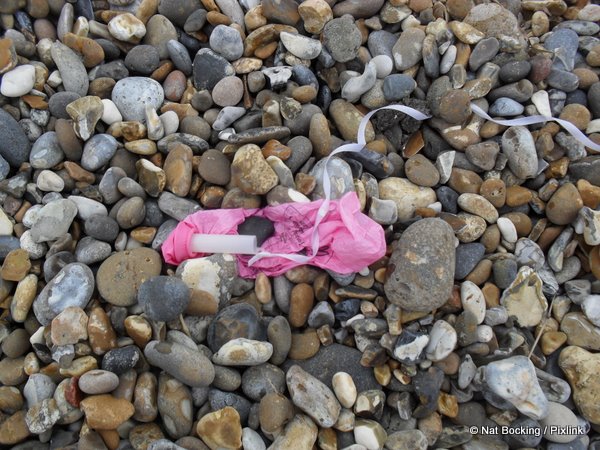 |
| Balloon litter found on Dunwich Beach |
Mainstream media has many responsibilities; the most paramount is to be fair, balanced and report the truth. It should not give balloon release organisers encouragement by advance or post-event publicity without at least reporting the harm they cause. This cycle of harm must be broken.
Every year there are thousands and thousands of balloon releases world-wide that were encouraged by every previous release and the photographs published in the media show the vast majority do not adhere to the balloon industry guidelines to only use latex balloons without any strings or tags. The very premise of the popular fundraising method of balloon races requires a tag on every balloon though. Every so-called "responsible" balloon release will spawn hundreds of much more harmful imitators. The general public cannot be trusted to observe release guidelines. The balloon industry cannot be relied on to impose them. In every society its moral standards sink to the limit of enforcement. What would our roads be like if our speed limits were merely guidelines?
 |
| Mylar balloon litter found in Suffolk |
Sometimes balloon releases are done as a memorial for a dead person, sometimes in tragic cases of children dying. A private expression of grief in this way is ill advised but is generally respected but memorial organisers often seek publicity for their memorials which only leads to more such releases.
People seek publicity for various reasons. Good causes usually want to raise awareness of their particular cause with a wider public. Balloon releases are cheap to to organise and seem to walk into content-hungry regional media without question. To approach people who plan and promote memorial releases after their announcement is very difficult. In my experience it's quite safe to generalise that they perceive even the most polite request as being insensitive to their grief. Should harmful expressions of grieving be permitted regardless? Is this suttee of wildlife and livestock and trashing of places of natural beauty acceptable?
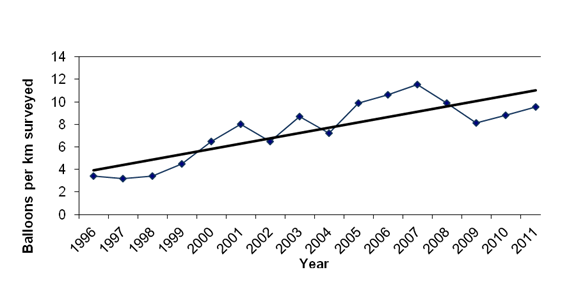 |
| density per km of balloon litter on Beachwatch surveys since 1996 |
Otherwise celebrities like Jeff Brazier shall continue to encourage his 35,000 twitter followers and readers on the Huffington Post blog to join him in releasing thousands of balloons in memory of Jade Goody planned for March 17th 2013. This is not private grieving and it demands a response that it is irresponsible. His particular (and not unusual) response is to block people who contact him on twitter politely asking him to reconsider.
Balloon releases need pre-emptive information to discourage them. That won't come from the balloon sellers. It won't come from local government who don't require any licenses to release balloons. It could come from the media who can either refuse to run the story or it could respond with "thank you for your submission but we don't promote littering and will report it as such when it happens".
 |
| anti litter campaigns are undermined by balloon releases |
The defence of releases that the balloons are biodegradable is a myth, put out by the balloon industry obviously to protect their interests. The great number of "turn-up" releases usually include Mylar balloons which are indestructible. But all this is beside the point. Balloon releases are simply littering. If people can be issued with Fixed Penalty Notices for dropping biodegradable fast food or similar litter, how
is it permissible to allow and promote littering by balloon releases? Why does the unacceptable disposing of something by dropping on the ground become acceptable by filling it with lighter-than-air gas and releasing it to fall to the ground later?
The legality of balloon releases is subject to debate. The law seems pretty clear that to "otherwise deposit" material is littering but enforcement is very selective. The Metropolitan Police chose not to determine that Lord Coe was littering when he released thousands of balloons to open the Olympic Stadium in May 2012, but whether something is legal, or quasi legal, it doesn't follow it is also acceptable. It used to be legal for a man to beat his wife or to send children into coal mines. Society seems to have a collective blindness to the implications of releasing TONNES of latex and plastic into the air every year in the UK to come down on water and land to leave an unsightly and dangerous mess.
The legality of balloon releases is subject to debate. The law seems pretty clear that to "otherwise deposit" material is littering but enforcement is very selective. The Metropolitan Police chose not to determine that Lord Coe was littering when he released thousands of balloons to open the Olympic Stadium in May 2012, but whether something is legal, or quasi legal, it doesn't follow it is also acceptable. It used to be legal for a man to beat his wife or to send children into coal mines. Society seems to have a collective blindness to the implications of releasing TONNES of latex and plastic into the air every year in the UK to come down on water and land to leave an unsightly and dangerous mess.
 |
| Another menace; the litter from a Chinese lantern |
A good number of organisations can provide scientific evidence of the harm of balloons being released, which is far from
limited to latex balloons. The RSPCA, National Farmers Union and anti-litter organisations have published guidance asking people not to release balloons. But whatever the scientific argument is, it's just a red herring. The
simple fact remains, to let a balloon go deliberately is just littering. No
good cause can justify that harm.
If you want more links and information, I suggest you
follow the hashtag #balloonrelease on twitter. Zilch.org.uk has begun tracking the number
of balloon releases reported in the media and on social media.
So if you are a journalist, I urge you to reconsider how you report balloon releases and the part you play in encouraging them. Otherwise you are complicit in this harm.
Thursday, 7 February 2013
Dealing with Dogging
A sure fire way to trigger snickers or invite suspicion about your morals is to raise the topic of 'dogging' and 'cruising' at a parish council meeting.
Someone in the public gallery might innocently ask what is this term? Well, it's a little bit indelicate but dogging is heterosexuals engaging in sex in a public place and cruising is homosexuals meeting up for anonymous sex, usually in public places.
Amendments to the Sexual Offences Act 2003 mean that outdoor sex is not in itself an offence. However, section 5 of the Public Order Act 1986 makes an offence of being threatening, abusive or insulting in a way which is likely to cause harassment, alarm or distress, which could include people engaging in public sexual activity.
Section 71 of the Sexual Offences Act 2003, makes it illegal to engage in a sexual act in a public toilet. The law applies equally to men and women and will be regarded as a ‘nuisance’ offence rather than a serious sex crime.
If you want to look it up further without tripping pornography blockers or to find the most relevant information; the subject is generally referred to as Public Sex Environments (PSE).
Puce-complexioned brigadiers might demand a police crackdown after complaints of PSE activity but the local constabulary are unlikely to immediately divert manpower to patrolling public toilets, country parks and lay-bys to catch people in the act. With limited budgets for police or ranger patrols, too often the only options to tackle PSE is removal these amenities for everyone by their closure.
Public sex is engaged in by people of every gender and sexual orientation and in both rural and urban environments. The public's concern seem to be less with heterosexual activity but greater when it involves homosexual activity. This leads to further marginalisation and victimisation of the gay community.
As far as I know, there isn't much mileage in considering the problem is different between heterosexual or homosexual men and women, or urban or rural area but urban or rural locations might determine different policing strategies. Many rural PSE are frequented by both 'straight' and 'gay' users.
In a survey of nuisance and criminal activity such as fly-tipping and vandalism in English country parks, problems with sexual activity was reported in 60% of them.
PSE are not new; 'lovers lanes' have been tolerated for years but they have always been problematic as they bring together incompatible parts of societies’ attitudes to morality and the law. The two are often out of step leaving PSEs not just a problem for lawmakers and the police, but more commonly for the residents and the users themselves.
PSE should be a concern for communities because:
- Sexual activity in a public place can cause offence or distress to those who unwillingly witness it and can result in people feeling intimidated when using public places and facilities.
- Users can make mistaken approaches to the public for sexual activity. This denies the public the right to use the amenities without molestation.
- There is often unsanitary litter (usually the first indication the area is a PSE) and increased general littering. The discarded material can affect the degree to which a site is seen as suitable for educational or recreational activities.
- There is damage to the environment or amenities such as trampling of undergrowth or damage to trees and damage to locks and gates and public toilet cubicles by contact graffiti and cutting of 'glory holes'.
- There is increased vehicle traffic at unsocial hours with longer utilisation of laybys thus less availability of them for their normal purpose and more vehicle erosion as users park off the road.
- Sex in a PSE is high-risk activity and generally users have multiple contacts. It is more often without condoms and so they have much greater risks of contracting and spreading STDs and HIV.
- PSE can eventually attract prostitution (not a crime in itself) and the associated criminal activity of drugs, trafficking and exploitation of children as well as filming and photography to produce pornography.
- Female users and to a lesser extent male users are at a greater risk of coercion and so rape.
The ‘established’ approach to policing PSE is to target the users. While effective in discouraging activity in certain areas, it can push the problem to other places which are harder to police. Policy to reduce PSE shows enlightened tolerance.
- PSE users can attract hate-crime persecution and they are often victims of assault, harassment and robbery and theft from vehicles and users also leave themselves open to blackmail. There is less likelihood that victims will report such crimes to the police. Victimisation and enforcement has also led to the ’outing’ of individuals, with tragic results, particularly if they are married men who do not identify with being gay or bisexual. Suicides are not uncommon.
- PSE activities are also a challenge for the staff at a site. Cleaning up the litter is an unpleasant task. When activities are disturbed, volunteers and staff often suffer embarrassment and some have been physically threatened by pimps and users wanting to discourage their presence. Unwitting visitors to PSE have greater risk of becoming victims of crime when there is a criminal element preying on PSE users.
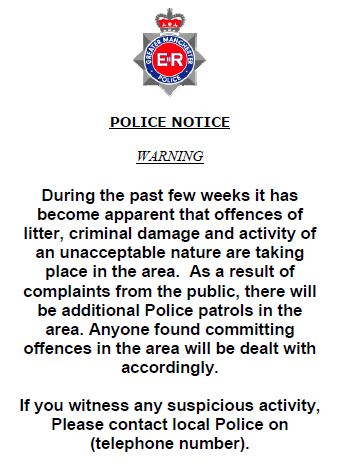
You can also find the Association of Chief Police Officer of England, Wales & Northern Ireland Guidance on Policing Public Sex
Environments.
The Suffolk approach to PSE complaints is the Scan Analyse Respond Assess (SARA) problem-solving method.
Within that is the Problem Analysis Triangle (PAT) that breaks incidents down into features of the victim, the offender and the location (also called the wolf, duck, den model). If you can reduce or remove one part of the model, the others cannot exist.
Like a pub with a bad reputation, PSE is predominantly a 'den' scenario but as closing that den removes an amenity from the public, the approach to address the 'wolf', the user who takes the opportunity to offend around a PSE and is not unrestricted from doing so by the furtive (though not necessarily illegal) nature of the activity, is to deter the 'ducks' the users who more likely to become victims of the criminals.
Unless there is a specific suggestion that a more serious offence such as sexual assault, someone being held against their will or a child or young person is involved with an adult, no deployment will be made.
Likewise, unless there is criminal activity such as theft, assault or drug dealing at a PSE, police efforts will be more focussed at first on informing users that their behaviour is exposing them to considerable risk of becoming a victim of crime or compromising their health and that of others.
This can be done in a variety of ways including using Gay Liaison Officers as a source of information and putting up posters. There is a difficult balance because visible enforcement or notices can advertise the site and actually increase the usage.
It is a conundrum too that while there is no criminal activity, this approach may be seen as a form of tolerance and police informing users of the risks they take may not be enough of a deterrence so creating the opportunity for criminal activity. Depending on the users, for instance men seeking men, there can be partnership working with LGBT health workers, such as the Terence Higgins Trust, to inform users of risk and encourage users to modify their behaviour so to reduce risk and the chance of conflict with other users of the space.
If the situation does not improve, the Partnerships and Safer Neighbourhoods Team could consider controlling access by restricting hours of opening and employing toilet attendants or park patrols trained to work within intervention protocols.
Other interventions could be:
The third step would be more frequent police patrols but their emphasis would be on information passing regarding the stepped process and the subsequent enforcement action that may be taken.
- Increased signage.
- Environmental design – landscaping and cutting back of shrubbery.
- Increased lighting.
- Overt surveillance, (e.g. CCTV).
- Staff vigilance and guidance (e.g. gardeners).
- Increased litter bins.
- Target removal, (e.g. closure of facilities).
- Patrols/intervention by accredited County Council wardens.
You should be careful in your media relations when dealing with issues surrounding public sexual activity as this can backfire by advertising a PSE and enable vigilantism or persecution. Whilst there are circumstances when localised leafleting is a viable option, the ‘outing’ of problem venues through the media is to be avoided. It can escalate fears, fuel prejudice and place all persons in that vicinity at risk.
In the future society may realise that managed tolerance through ’zoning’ presents the best opportunity to tackle a growing problem and tackle the influences which degrade some of society’s most valued recreational and conservation resources.
Subscribe to:
Posts (Atom)