Friday, 8 March 2013

Breaking the cycle of harm


I saw a balloon release story in yet another regional newspaper today.

A balloon release story is an evergreen staple of the national and regional media. If there are hundreds reported in online editions every year for good causes, in all likelihood there are thousands of them occurring in the UK. They are increasingly popular at weddings and charity fundraising events as well as memorials.

I must point you to photographs of my beaches in Suffolk as to why I object to any balloon release.

As a journalist myself, I have begun to ask journalists to report balloon releases accurately for what they are: simple littering. Balloon release reports rarely mention their impact on the environment. Any mention of impact is usually a reassurance they are harmless, often quoting a balloon vendor or their proxy the event organiser. In ideal conditions a single natural latex balloon will eventually decay but 'ideal' is not the same as 'always' and releases are rarely limited to a single balloon without tags, plastic ties or strings. It's another tragedy of the commons where each person justifies it by "just one won't hurt".

Balloon releases are mainly done for publicity. They are a photogenic story but, in general, the print and television news media is totally negligent in reporting the harm that they cause or even questioning their impact.
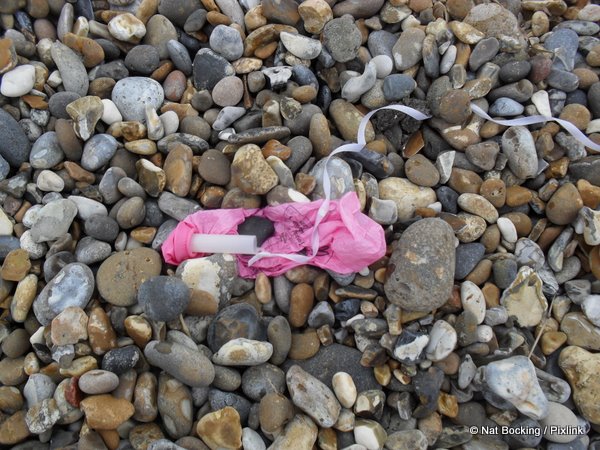

Balloon litter found on Dunwich Beach

Mainstream media has many responsibilities; the most paramount is to be fair, balanced and report the truth. It should not give balloon release organisers encouragement by advance or post-event publicity without at least reporting the harm they cause. This cycle of harm must be broken.

Every year there are thousands and thousands of balloon releases world-wide that were encouraged by every previous release and the photographs published in the media show the vast majority do not adhere to the balloon industry guidelines to only use latex balloons without any strings or tags. The very premise of the popular fundraising method of balloon races requires a tag on every balloon though. Every so-called "responsible" balloon release will spawn hundreds of much more harmful imitators. The general public cannot be trusted to observe release guidelines. The balloon industry cannot be relied on to impose them. In every society its moral standards sink to the limit of enforcement. What would our roads be like if our speed limits were merely guidelines?

Mylar balloon litter found in Suffolk

Sometimes balloon releases are done as a memorial for a dead person, sometimes in tragic cases of children dying. A private expression of grief in this way is ill advised but is generally respected but memorial organisers often seek publicity for their memorials which only leads to more such releases. 

People seek publicity for various reasons. Good causes usually want to raise awareness of their particular cause with a  wider public. Balloon releases are cheap to to organise and seem to walk into content-hungry regional media without question. To approach people who plan and promote memorial releases after their announcement is very difficult. In my experience it's quite safe to generalise that they perceive even the most polite request as being insensitive to their grief. Should harmful expressions of grieving be permitted regardless? Is this suttee of wildlife and livestock and trashing of places of natural beauty acceptable? 
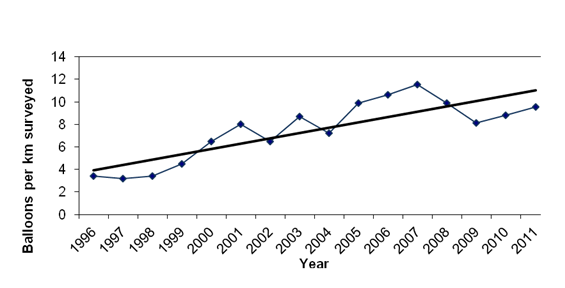
density per km of balloon litter on Beachwatch surveys since 1996

Otherwise celebrities like Jeff Brazier shall continue to encourage his 35,000 twitter followers and readers on the Huffington Post blog to join him in releasing thousands of balloons in memory of Jade Goody planned for March 17th 2013. This is not private grieving and it demands a response that it is irresponsible. His particular (and not unusual) response is to block people who contact him on twitter politely asking him to reconsider.

Balloon releases need pre-emptive information to discourage them. That won't come from the balloon sellers. It won't come from local government who don't require any licenses to release balloons. It could come from the media who can either refuse to run the story or it could respond with "thank you for your submission but we don't promote littering and will report it as such when it happens".


anti litter campaigns are undermined by balloon releases

The defence of releases that the balloons are biodegradable is a myth, put out by the balloon industry obviously to protect their interests. The great number of "turn-up" releases usually include Mylar balloons which are indestructible. But all this is beside the point. Balloon releases are simply littering. If people can be issued with Fixed Penalty Notices for dropping biodegradable fast food or similar litter, how is it permissible to allow and promote littering by balloon releases? Why does the unacceptable disposing of something by dropping on the ground become acceptable by filling it with lighter-than-air gas and releasing it to fall to the ground later?

The legality of balloon releases is subject to debate. The law seems pretty clear that to "otherwise deposit" material is littering but enforcement is very selective. The Metropolitan Police chose not to determine that Lord Coe was littering when he released thousands of balloons to open the Olympic Stadium in May 2012, but whether something is legal, or quasi legal, it doesn't follow it is also acceptable. It used to be legal for a man to beat his wife or to send children into coal mines. Society seems to have a collective blindness to the implications of releasing TONNES of latex and plastic into the air every year in the UK to come down on water and land to leave an unsightly and dangerous mess.

Another menace; the litter from a Chinese lantern
A good number of organisations can provide scientific evidence of the harm of balloons being released, which is far from limited to latex balloons. The RSPCA, National Farmers Union and anti-litter organisations have published guidance asking people not to release balloons. But whatever the scientific argument is, it's just a red herring. The simple fact remains, to let a balloon go deliberately is just littering. No good cause can justify that harm.

If you want more links and information, I suggest you follow the hashtag #balloonrelease on twitter. Zilch.org.uk has begun tracking the number of balloon releases reported in the media and on social media.

So if you are a journalist, I urge you to reconsider how you report balloon releases and the part you play in encouraging them. Otherwise you are complicit in this harm.

Thursday, 7 February 2013

Dealing with Dogging


A sure fire way to trigger snickers or invite suspicion about your morals is to raise the topic of 'dogging' and 'cruising' at a parish council meeting.

Someone in the public gallery might innocently ask what is this term? Well, it's a little bit indelicate but dogging is heterosexuals engaging in sex in a public place and cruising is homosexuals meeting up for anonymous sex, usually in public places.

Amendments to the Sexual Offences Act 2003 mean that outdoor sex is not in itself an offence. However, section 5 of the Public Order Act 1986 makes an offence of being threatening, abusive or insulting in a way which is likely to cause harassment, alarm or distress, which could include people engaging in public sexual activity.

Section 71 of the Sexual Offences Act 2003, makes it illegal to engage in a sexual act in a public toilet. The law applies equally to men and women and will be regarded as a ‘nuisance’ offence rather than a serious sex crime.

If you want to look it up further without tripping pornography blockers or to find the most relevant information; the subject is generally referred to as Public Sex Environments (PSE).

Puce-complexioned brigadiers might demand a police crackdown after complaints of PSE activity but the local constabulary are unlikely to immediately divert manpower to patrolling public toilets, country parks and lay-bys to catch people in the act. With limited budgets for police or ranger patrols, too often the only options to tackle PSE is removal these amenities for everyone by their closure.

Public sex is engaged in by people of every gender and sexual orientation and in both rural and urban environments. The public's concern seem to be less with heterosexual activity but greater when it involves homosexual activity. This leads to further marginalisation and victimisation of the gay community.

As far as I know, there isn't much mileage in considering the problem is different between heterosexual or homosexual men and women, or urban or rural area but urban or rural locations might determine different policing strategies. Many rural PSE are frequented by both 'straight' and 'gay' users.

In a survey of nuisance and criminal activity such as fly-tipping and vandalism in English country parks, problems with sexual activity was reported in 60% of them.

PSE are not new; 'lovers lanes' have been tolerated for years but they have always been problematic as they bring together incompatible parts of societies’ attitudes to morality and the law. The two are often out of step leaving PSEs not just a problem for lawmakers and the police, but more commonly for the residents and the users themselves.

PSE should be a concern for communities because:
  • Sexual activity in a public place can cause offence or distress to those who unwillingly witness it and can result in people feeling intimidated when using public places and facilities.
  • Users can make mistaken approaches to the public for sexual activity. This denies the public the right to use the amenities without molestation.
  • There is often unsanitary litter (usually the first indication the area is a PSE) and increased general littering. The discarded material can affect the degree to which a site is seen as suitable for educational or recreational activities.
  • There is damage to the environment or amenities such as trampling of undergrowth or damage to trees and damage to locks and gates and public toilet cubicles by contact graffiti and cutting of 'glory holes'.
  • There is increased vehicle traffic at unsocial hours with longer utilisation of laybys thus less availability of them for their normal purpose and more vehicle erosion as users park off the road.
  • Sex in a PSE is high-risk activity and generally users have multiple contacts. It is more often without condoms and so they have much greater risks of contracting and spreading STDs and HIV.
  • PSE can eventually attract prostitution (not a crime in itself) and the associated criminal activity of drugs, trafficking and exploitation of children as well as filming and photography to produce pornography.
  • Female users and to a lesser extent male users are at a greater risk of coercion and so rape.
  • PSE users can attract hate-crime persecution and they are often victims of assault, harassment and robbery and theft from vehicles and users also leave themselves open to blackmail. There is less likelihood that victims will report such crimes to the police. Victimisation and enforcement has also led to the ’outing’ of individuals, with tragic results, particularly if they are married men who do not identify with being gay or bisexual. Suicides are not uncommon.
  • PSE activities are also a challenge for the staff at a site. Cleaning up the litter is an unpleasant task. When activities are disturbed, volunteers and staff often suffer embarrassment and some have been physically threatened by pimps and users wanting to discourage their presence. Unwitting visitors to PSE have greater risk of becoming victims of crime when there is a criminal element preying on PSE users.
The ‘established’ approach to policing PSE is to target the users. While effective in discouraging activity in certain areas, it can push the problem to other places which are harder to police.  Policy to reduce PSE shows enlightened tolerance.

The Suffolk Constabulary Policies & Procedures: Policing of Public Sexual Activity / Managing Public Sex Environments is well worth reading.

You can also find the Association of Chief Police Officer of England, Wales & Northern Ireland Guidance on Policing Public Sex
Environments.

The Suffolk approach to PSE complaints is the Scan Analyse Respond Assess (SARA) problem-solving method.

Within that is the Problem Analysis Triangle (PAT) that breaks incidents down into features of the victim, the offender and the location (also called the wolf, duck, den model). If you can reduce or remove one part of the model, the others cannot exist.

Like a pub with a bad reputation, PSE is predominantly a 'den' scenario but as closing that den removes an amenity from the public, the approach to address the 'wolf', the user who takes the opportunity to offend around a PSE and is not unrestricted from doing so by the furtive (though not necessarily illegal) nature of the activity, is to deter the 'ducks' the users who more likely to become victims of the criminals.

Unless there is a specific suggestion that a more serious offence such as sexual assault, someone being held against their will or a child or young person is involved with an adult, no deployment will be made.

Likewise, unless there is criminal activity such as theft, assault or drug dealing at a PSE, police efforts will be more focussed at first on informing users that their behaviour is exposing them to considerable risk of becoming a victim of crime or compromising their health and that of others.

This can be done in a variety of ways including using Gay Liaison Officers as a source of information and putting up posters. There is a difficult balance because visible enforcement or notices can advertise the site and actually increase the usage.

It is a conundrum too that while there is no criminal activity, this approach may be seen as a form of tolerance and police informing users of the risks they take may not be enough of a deterrence so creating the opportunity for criminal activity. Depending on the users, for instance men seeking men, there can be partnership working with LGBT health workers, such as the Terence Higgins Trust, to inform users of risk and encourage users to modify their behaviour so to reduce risk and the chance of conflict with other users of the space.

If the situation does not improve, the Partnerships and Safer Neighbourhoods Team could  consider controlling access by restricting hours of opening and employing  toilet attendants or park patrols trained to work within intervention protocols.

Other interventions could be:
  • Increased signage.
  • Environmental design – landscaping and cutting back of shrubbery.
  • Increased lighting.
  • Overt surveillance, (e.g. CCTV).
  • Staff vigilance and guidance (e.g. gardeners).
  • Increased litter bins.
  • Target removal, (e.g. closure of facilities).
  • Patrols/intervention by accredited County Council wardens.
The third step would be more frequent police patrols but their emphasis would be on information passing regarding the stepped process and the subsequent enforcement action that may be taken.

You should be careful in your media relations when dealing with issues surrounding public sexual activity as this can backfire by advertising a PSE and enable vigilantism or persecution. Whilst there are circumstances when localised leafleting is a viable option, the ‘outing’ of problem venues through the media is to be avoided. It can escalate fears, fuel prejudice and place all persons in that vicinity at risk.

In the future society may realise that managed tolerance through ’zoning’ presents the best opportunity to tackle a growing problem and tackle the influences which degrade some of society’s most valued recreational and conservation resources.

Saturday, 8 December 2012

Props

Me and Reginald VelJohnson: They Shoot Ducks, Don't They? (ep 195). First aired Friday, Sep 26 1997

I used to do movie and TV props. Here I am on Family Matters, the second longest running family sitcom after the Cosby Show. If I recall, I did props on a few episodes as a day-player then joined the crew permanently from episode 111 to the end, 103 episodes later.

Wednesday, 5 December 2012

The Big Idea: Education from the bottom up


(This article was this week’s lead article in the Royal Society of Art’s journal. I have been pleased to be working with 2020 in Suffolk)

2020 Education is a school-based initiative empowering young people aged 11-18 to articulate the challenges and opportunities for the world in 2020 and their own practical solutions, using film and social media. The aim is to engage pupils in thinking – and taking action – about major issues such as conservation, extremism, and fair trade. The best ideas, chosen by the students themselves, are then shared globally using film and social media. The project was initially proposed by Andrew Hadley who pulled a group of Fellows together to work on the project. 

2020 Education, initially awarded RSA Catalyst funds in January 2012, shows how global issues can be tackled locally in practical ways. As Andrew says, "Our approach is bottom up, about participation and empowerment of young people. We need to help them make sense of the issues and articulate these to their peers as well as create and promote their own imaginative solutions. But the skills and experience they gain in the process are also what they need to get into the world of work. So 2020 Education links the future prospects of individuals with those of the planet".

Andrew and his team identified some of the most interesting school projects from around the country which engage pupils aged 11-18 on global themes of mutuality, sustainability and enterprise. They then created short films, which were presented at an event in Oxford on 26 June 2012. You can watch the films online. Projects included fair trade coffee, rare orchid propagation, beekeeping and raising awareness of children’s rights. The schools involved were encouraged to use social media to share ideas and develop new collaborations through peer education.

The event involved 11 UK schools (state, independent, primary, secondary) and a group from 4 countries of Southern Africa. The event, held at the Said Business School, Oxford, also attracted guests such as Dr James Martin, Rageh Omaar, Jasmine Whitbread, John Baugh, Mark Robinson, Sir Alec Reed, representatives of the RSA, Ashoka Foundation, Greenpower, the Prince’s Trust, and others. The Children’s Radio Foundation also joined the project as a partner, leading to a broadcast on the BBC World Service.

Reaction to the films and the Oxford event has been so positive, with many more schools expressing interest in joining the programme, that the team now have ambitious targets for rolling out the programme nationally and internationally over the next 7 years. “We believe creative ideas can come out of schools in Latin America, India and Africa just as much as from the UK,” said Andrew, “We’re keen to use the RSA’s international network to help us expand into those regions.”

2020 Education have now been awarded additional Catalyst funds to take their project further. They are aiming to hold a series of roadshows and engage 100 schools in the coming months, leading to a second showcase event next summer. Initially the focus is on schools in the UK, but links are also already being made internationally.

Andrew commented: “2020 Education is about adding value to classroom learning. We aim to recognise the brilliant projects some schools are already running, link them together, and inspire others to start their own, with the young people themselves leading the way. We are also very open to partnerships with other organisations.”

There are many ways RSA Fellows can get involved. The 2020 team are keen to hear from any Fellows with interests in education, social media (particularly in relation to schools), or willing to act as trainers or mentors. They will also welcome advice about marketing and fundraising. To begin with, the priority is to identify and contact schools which have set up innovative projects or which encourage creative approaches to learning beyond the classroom.


Friday, 30 November 2012

Neirs is not so far away...

It was in 2008 that we first flew from Stansted to Weeze (pronounced Vetzer) on one of Ryanair's one penny flights.


After I wrote a story a story about it for the German news site The Local on the delightful the town of Kevelaer, which is a twin town of Bury St. Edmunds, and the nearby family theme park Irrland and the efficiency of the local public transport, I was contacted by Kevin Betts, the proprietor of Kevin's Pub, a guesthouse in Weeze saying if I ever came back, he'd like to show me his small hotel and bar/restaurant and have me try his canoes on the Niers river.

It was a tempting offer but unfortunately my efforts to promote Germany to British tourists must have worked too well as within a year the traffic to Niederrhein Airport, the former RAF Laarbruch (pron. Larbrook), had increased so much, the one penny fares were now like hens teeth as people discovered the airport was a cheap gateway to Europe.

Google hits on my newspaper story and blog entry brought me all sorts of enquiries on connections with the German and Dutch train network - which are very good - and Ryanair's rather deceptive advertising about its proximity to Düsseldorf.

One day we thought it would great family fun to go canoeing somewhere like the Lake District but after working out what that would cost in the UK, another visit to Germany seemed very attractive.

So in June 2010 we made our second visit to Weeze; planning on a sparrowfart departure from our home in Suffolk to catch the 7:20 AM from Stansted and returning on the 20:15 the same day as we had done before, costing us a very reasonable £15 per person each way, once we'd got ourselves a euro debit card. We also invited along a travel writer keen to practise her German because I had noted in our prior trip, British visitors to the area are so few (perhaps for reasons we mustn't mention!) there is very practically no tourism information provided in English yet everything is dutifully reproduced in French, Dutch and Belgian.

There's not much point in hating on Ryanair as everyone does it but even if Saile & Sabga coffee is Fairtrade, this instant coffee Ryanair serves is utterly vile and 3 euros too. I'd fire the expert who thought this would be a good way to promote their brand. Perhaps they know Ryanair passengers don't expect a pleasant experience, they just want the result they paid for. In this case a jolt of caffeine is all you should expect.


On arrival at Weeze we noticed things had really changed. No longer was the airport deader than a rural market town on a Tuesday night but the queue for the taxis snaked around the terminal. We had figured a taxi was cheaper than five bus fares and it would be faster so we passed up the hourly bus into town, at least the line was moving.

Wrong decision! It took nearly an hour to just to get within single figures of passengers ahead of us. The stream of taxis arriving at the airport became a trickle and then suddenly dried up and we waited for another half an hour while no more taxis arrived. I learned from an airport employee that taxi drivers come from far and wide to collect passengers at Weeze and many are going over the border to the university town of Nijmegen or Düsseldorf with their fares but there aren't that many local taxi companies. There was a big religious festival starting tomorrow so today was their busiest of the summer. With the clock counting down I rang Kevin to say we'd be late for our planned arrival. Kevin said "why didn't you say so..." and he jumped in his van and collected us.


Driving around the abandoned air base (its beautiful desolation captured here) Kevin told us that he was originally from Cornwall but stationed here as a young military policemen he'd married a German girl and never felt since he wanted to go back. The Royal Air Force Station Laarbruch was one of four 'Clutch' air bases of the British air forces in Germany during the Cold War. There's a museum with lots of memorabilia and a Bloodhound and Rapier missile, a ZPU2 AAA gun and Canberra and Buccaneer cockpits. The base motto was "Ein Feste Burg" or in English: A Party Town! British Forces News have a story about the base closure and redevelopment that either Youtube or Blogger won't let me embed.

We got to Kevin's place in under five minutes from the airport to be greeted with a warm welcome from his family and a full-on traditional German breakfast of fresh rolls, meats, jams and boiled eggs, all done to perfection and lots of good coffee. Kevin talked us through what sort of canoes we'd like to use - he has Canadian and kayaks - and how far we wanted to paddle and then suggested an itinerary for us.  After a tour of his place and their 'Hay Hotel', a big barn you can bed down in straw for a few euros, we set off for the Niers and a thorough briefing on river safety. He also provided water tight drums to stow our gear.

safety instructions

Launch point

Within five minutes we'd seen otters playing in the water.

We paddled downstream and the river was wide and placid and without motorboat traffic. All of us are good swimmers and the water was not very deep so we felt comfortable dispensing with life jackets and helmets, though I wouldn't do that on the Broads.  

Within five minutes we saw our first family of otters in the wild, scampering about on the bank and playing in the water, something that would be truly remarkable in the UK. They are just as cute in the wild as they are in the sanctuaries they need in Britain. I'm not much of a twitcher so I couldn't identify all the copious wildlife we saw apart from swans and ducks but there are grey herons which are huge when you get close to them.


http://www.kanoroutes.nl/e-niers.htm

Paddling a Canadian canoe is quite easy although it does take a lot of coordination between the front who has to be the 'engine' and the rear to be the 'driver'. Along the banks were herds of cattle - destined for bratwurst we think - and several impressive schloss and orderly plantations of oak trees lining the roads and willows creating shady banks. Happy families like ours cycled past on the path. According to a river guidebook, a little way down stream a sign says: "Dear paddler, you have reached a renewed river, please stop and drift a while for the best view."

Our stop was to be the town of Kevelaer. Here under a road bridge was a dock where we pulled up the boats and left them on the bank as Kevin had told us, he was confident the local NEETs wouldn't bother to take them for a joyride. I wondered if any towns like that existed in England. We then strolled around sightseeing, the first stop on the kid's itinerary was to hit the shops for chocolate. We found a legacy of a massive British presence here for last forty years was most of the local's speak perfect English. Once sated, and as we had visited the town before, we quickly ticked off the must-see sites like the museum and then headed to do what we'd unfortunately missed on our first visit, to have lunch in the Golden Swan. 


A stroll around the town and lunch

It was a lovely lunch and and their schnitzel we sampled for the sake of being a typical tourist was perfect and the sun was shining. As we sat in their pleasant garden the kids were amused by a playground and we started to feel the fact that we'd got up very early that morning. The restaurant staff were very attentive and so yes, we'll have another round of beers, thank you. The Golden Swan is what the English call a country coaching inn; it has rooms and it offer both formal and casual dining and it even has a traditional bowling alley.


Pilgrim statue
We reluctantly dragged ourselves away to get back to the boats and stowed coats which were just as we found them. When back on the water we found after a while we were making slower progress than we had the morning, a change of engine and driver still needed more time to work it out but, being siblings, neither going to concede control to the other. The uncertainty of getting back to Weeze and Ryanair's strict rules about check-in times began to concern me.

I rang Kevin to describe where we were, we had just passed a chain ferry, and he sounded doubtful we'd get to our planned meeting point at Geldern about two miles further but we would soon be coming up to another dock and if we stopped there, he'd collect us. It took another half an hour of paddling and by then the portaloos there were a welcome relief for the girls. Kevin quickly loaded us all up and took us back the pub to wash and settle up and he then took us to the airport bang on the latest check-in time. We said our goodbyes. By then he'd done more than enough to deserve a good write up on Tripadvisor.


Thanks Kevin!
Weeze airport's security, customs and immigration halls are akin to a country train station where a solitary stationmaster is the ticket clerk, porter and crossing guard so you can pass through in a minute but then you have nothing to do on air-side to wait for hours for the plane to arrive. Unless the airport is very busy, it's best to wait on the ground-side until you're absolutely certain your plane is incoming by checking with flightradar24.com. But whatever you do, don't be late for the check-in time on your ticket.

Our plane ended up being an hour late but the departure board just repeated the same lie of imminent arrival over and over. Not wanting to stop at Stansted airport or en-route for supper, we were mighty thankful for Kevin's wife pressing on us the leftover 'aufschnitt' and rolls and so had a picnic in the departure lounge.


The museum is well worth a look

For two airport transfers, portage to the launch and collection, hire of 2 three-seater canoes and a full breakfast - all done on his Tuesday day off - we had paid 120 euros including tip. For an utterly memorable day out for five people, that is unbeatable. I appreciate inflation may take its toll, your mileage may differ. All-in it was less outlay for us than a recent trip to Alton Towers.

Far be it for me to suggest this is the best itinerary but given the public transport links: seeing the RAF museum and a day at Irrland, overnight at Kevin's and a day on the river and sightseeing in Kevelaer would be a great two-day family break. I should book now for half-term. There are many other attractions nearby I would like to explore myself including Wunderland, a massive theme park-hotel complex inside an unfinished power station.

If you live in reach of Stansted, Leeds or Edinburgh and you're really canny, you can also use Weeze as stop-over as there are plenty of bargain flights from here to Portugal, Italy, Spain, Greece and other places that British, Dutch and German holidaymakers seeking sunshine go to.

Kevin's canoeing season starts on the 15th April and runs until the 15th October.

The Niers is a river in Germany and the Netherlands, right tributary to the river Meuse. Its source is near Erkelenz, south of Mönchengladbach, in North Rhine-Westphalia (Germany). The Niers flows through Mönchengladbach, Viersen, Wachtendonk, Geldern and Goch before flowing into the Meuse just across the border with the Netherlands, in Gennep. Its total length is 116 km - 108 km in Germany, 8 km in the Netherlands.